Morphometric characterization using a multivariate approach: The case of cattle breeds raised on traditional cattle farms in northern Côte d’Ivoire
Franck Armand Désiré Yaoa, b, *, Jean-Yves Ekraa, Kpahé Herbert Michaël Kanha, N’Goran Etienne Loukoua, Acho Max Didier Attaa, b, Armand Kangahc, Bernard Tiedec, Menama Konec, Zié Aboubakar Armel Bambad, Enock Bokac and Kouamé Edouard N’Gorana
a Département de Biochimie-Génétique, Unité de Formation et de Recherche (UFR) des Sciences Biologiques, Université Peleforo GON COULIBALY, Korhogo BP1328, Côte d’Ivoire
b Institut de l’environnement et de recherches agricoles, 03 BP 7041 Ouagadougou 03, Burkina Faso
c Ministère des Ressources Animales et Halieutiques (MIRAH), Abidjan BP3657, Côte d’Ivoire
d Département de Géosciences, Unité de Formation et de Recherche (UFR) des Sciences Biologiques, Université Peleforo GON COULIBALY, Korhogo BP1328, Côte d’Ivoire
* Corresponding author: Franck Armand Désiré Yao
(franckyaodesire@gmail.com)
Abstract: One of the major constraints to cattle breeding development in Côte d’Ivoire is the limited knowledge of the genetic composition of the national herd. To address this gap, a study was carried out on livestock farms in the northern (Poro, Bagoué, and Tchologo) and northeastern (Bounkani) regions to identify and characterize the breeds and genetic types of Ivorian cattle. Farmers’ identifications were recorded, and 275 animals comprising 24 N’Dama, 15 Baoulé, 86 Zebu, 138 Méré, and 12 exotic crossbreeds were described using 27 morphological descriptors (13 qualitative and 14 quantitative). Descriptive analysis showed that qualitative traits were unreliable for breed differentiation. However, multivariate analysis of quantitative traits revealed significant morphological differences (p < 0.05) among genetic types. Exotic crossbreeds and Zebu exhibited significantly greater body measurements (p < 0.05) than Baoulé and N’Dama cattle. Four descriptors, height at withers, horn length, muzzle circumference, and head length, accounted for most of these variations. The significance of Mahalanobis distances (p < 0.05) confirmed that the breeds form distinct populations. Nonetheless, the moderate reclassification rates indicate overlaps and potential misidentification based on morphology alone. These findings highlight the limitations of phenotypic characterization and underscore the need for molecular analyses to clarify the genetic structure and relationships among Ivorian cattle breeds and genetic types.
Keywords: Cattle, breeds, morphometry, characterization, Côte d’Ivoire
Introduction
Livestock farming is an important activity that contributes to improving food security, diversifying and increasing the incomes of farmers and breeders, as well as helping to preserve and improve the environment (Cesaro & Apolloni 2020). In Côte d'Ivoire, this sector remains a secondary activity (MIRAH, 2022).
The Ivorian cattle herd is originally made up of three local breeds of bull (Taurine): N'Dama, Baoulé, and Lagunaire (Yapi-Gnaore et al, 1996), which are trypanotolerant and well adapted to local dietary and pathological conditions and environments. However, low herd productivity, the lack of valorization of local breeds, and limited awareness of their contribution to sustainable agriculture have led both breeders and political decision-makers to use these local breeds for uncontrolled cross-breeding with Zebu cattle from transhumant herds coming from neighbouring northern countries and with exotic improved breeds (Sokouri et al, 2007, 2009; Soro et al, 2015a).
These uncontrolled crossbreeding practices have left Côte d'Ivoire with a cattle population that has suffered genetic erosion of local breeds and whose identity remains unclear (Sokouri et al, 2007, 2009; N’Goran et al, 2008, 2015; Ndiaye et al, 2014). If no action is taken, these crossbreeding practices may lead to the dilution of the genetic stability of local breeds. However, their production capacity, even in unfavourable conditions, makes local breeds a valuable heritage to be preserved for future innovations in livestock farming (Naves et al, 2011). Yet, any programme for the conservation and improvement of livestock requires prior in-depth knowledge of the genetic resources available (FAO, 2012). Phenotypic characterization is a fundamental step towards acquiring such knowledge. With this in mind, the present study was conducted to identify and describe the cattle breeds raised on smallholder farms in northern Côte d'Ivoire. The objective was to identify the distinctive physical traits of the breeds or genetic types that make up the national cattle population.
Materials and methods
Study area
The study was conducted in four regions of Côte d'Ivoire (Figure 1). These are three regions in the Savanes district (Poro, Tchologo, and Bagoué) in the north and the Bounkani region in the north-east of Côte d'Ivoire. They are traditionally cattle-raising regions in Côte d'Ivoire and account for 80% of the country's cattle population (Kouamé et al, 2024).
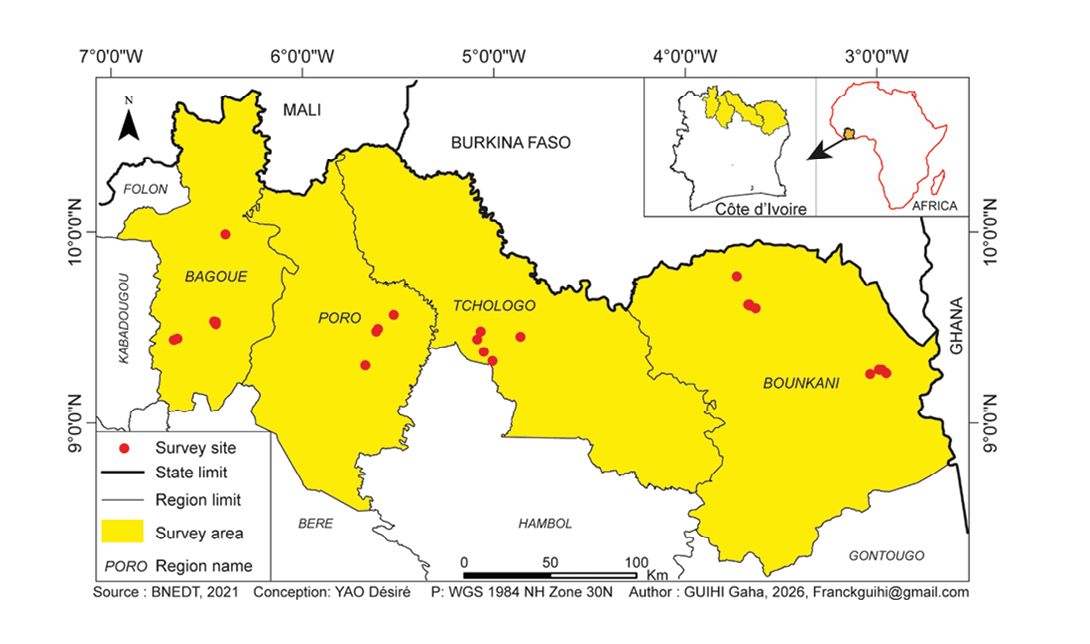
The Poro region (9°27' N, 5°39' W) spans 12,620km² and is home to approximately 1,040,461 inhabitants (INS, 2022). Its Sudanese climate is characterized by a long dry season from November to April, punctuated by the Harmattan between December and February, and a rainy season from May to October, with annual rainfall ranging between 950 and 1,200mm, peaking in August (FAO, 2005). Surveys were conducted in the departments of Korhogo and Dikodougou.
The Bagoué region (9°31' N, 6°29' W), covering 10,188km² and home to 515,890 inhabitants, shares a Sudanese tropical climate similar to that of Poro. Average temperatures hover around 27°C, with maximum values recorded between March and April, while rainfall during the wet season reaches 1,400 to 1,600mm (FAO, 2005; INS, 2022). Investigations were carried out in the departments of Boundiali and Kouto.
The Tchologo region (9°35' N, 5°12' W) covers 17,253km² with a population of 603,084 inhabitants (INS, 2022). Subject to a classic Sudanese climate, it experiences a dry season from November to April and a rainy season from May to October. The average annual temperature stands at 27.2°C, and can rise to as high as 38°C in March (FAO, 2005). Only localities in the department of Ferkessédougou were surveyed.
The Bounkani region (9°16' N, 3°00' W), located in the north-east and covering an area of 21,800km², is governed by a Sudano-Guinean climate. Annual precipitation ranges from 1,036 to 1,200mm, with a rainy season concentrated mainly between April and June and a dry season stretching from November to March (FAO, 2005). With 427,037 inhabitants according to the latest general census (INS, 2022), this region was explored through the departments of Bouna and Téhini.
Sampling, data collection and criteria for inclusion of individuals
Data collection was carried out through single-visit cross-sectional surveys, using an individual record sheet for each animal. Sampling covered seven departments across the regions of Poro, Bagoué, Tchologo, and Bounkani, selected based on the presence of the target breeds. In each region, at least five localities were surveyed. In total, 53 farms were included, with 14 in Poro, 8 in Tchologo, 17 in Bounkani, and 14 in Bagoué.
The selection of farms was conducted with the support of veterinary services from the regional and departmental directorates of the Ministry of Animal and Fisheries Resources (MIRAH), as well as according to the willingness of farmers to participate in the study.
Animal selection was based on age, health status, and the physiological status of females. The phenotypic type of each animal was reported by the farmer, while age was estimated through examination of dentition or determined from the animals’ date of birth. To minimize relatedness, a maximum of five animals per farm was selected. The animals included were adult cattle aged at least four years.
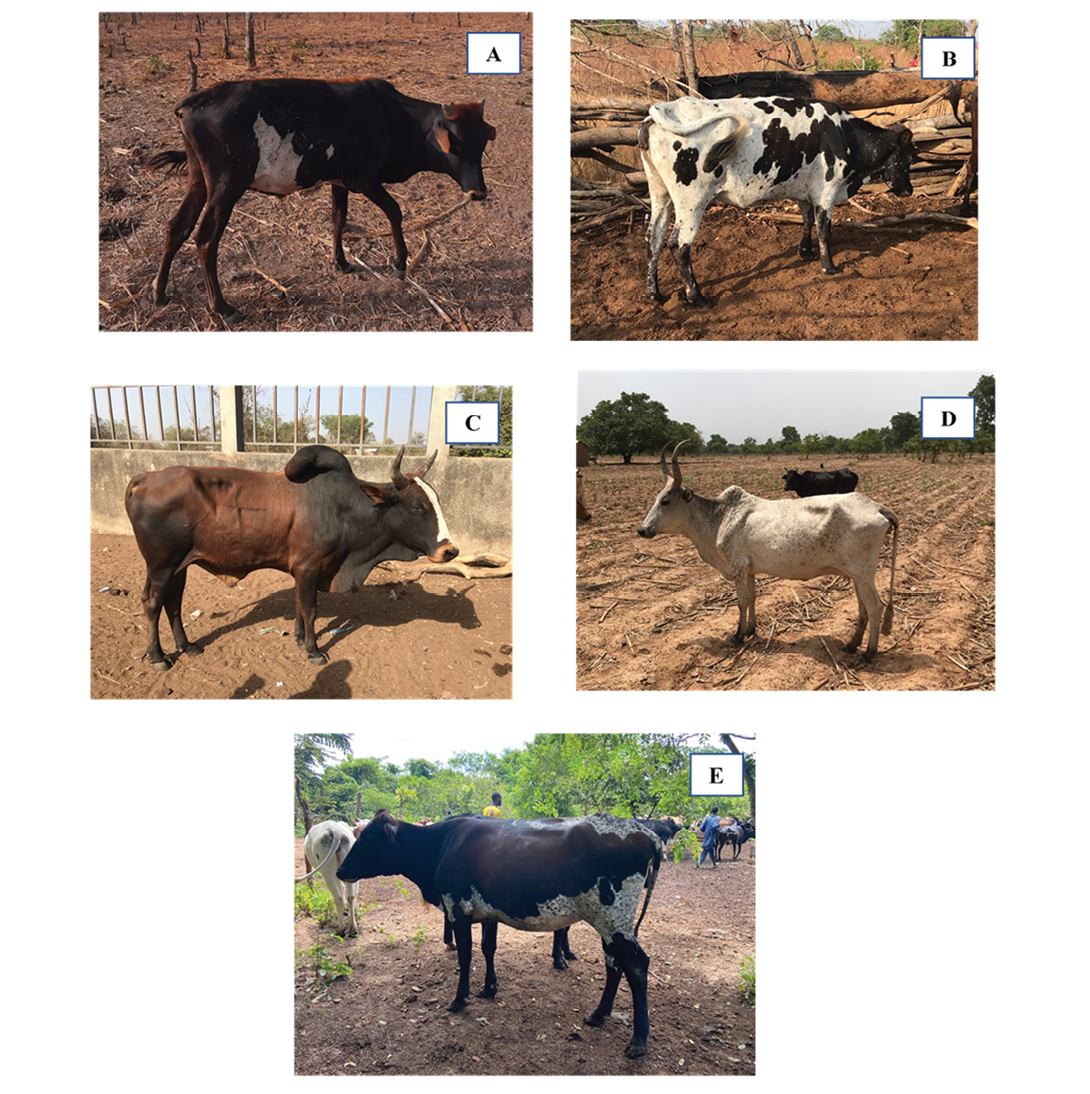
In total, 275 animals were studied across 53 farms located in four regions of northern Côte d’Ivoire. The distribution of the sample was as follows: 15 Baoulé taurine cattle (Figure 2A), 24 N’Dama taurine cattle (Figure 2B), 86 Zebu cattle (Figure 2C), 138 Méré-type cattle (Figure 2D), and 12 exotic crossbreeds (Figure 2E). The term ‘exotic crossbreeds’ refers to any crossbred animal with at least one parent of exotic origin.
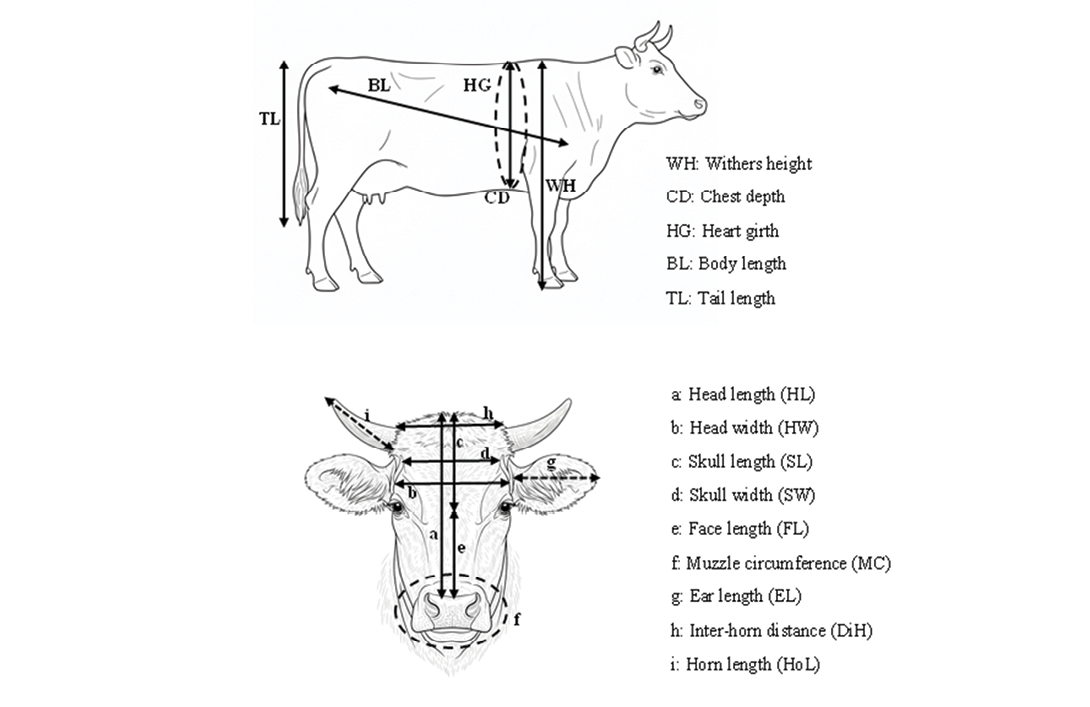
A total of 27 morphological descriptors (Figure 3) were assessed, including 14 quantitative and 13 qualitative, in accordance with (FAO, 2012) recommendations for the characterization of animal genetic resources. Measurements of quantitative descriptors were carried out after the animal was restrained by the farmer on a flat floor. They were taken using a measuring stick and a measuring tape. Qualitative descriptors, for their part, were assessed through direct visual observation.
All data were collected by the same team to avoid any bias in the measurements. Figure 3 illustrates the morphometric descriptors measured.
Statistical analysis
All these analyses were performed using R software, version 4.4.2 (R Core Team, 2024).
Basic descriptive analysis (frequencies) was performed on qualitative data to understand the representativeness of the animals described according to qualitative variables. A Chi-square (χ²) test of independence was conducted at a 5% significance level to evaluate the association between the explanatory variable (breed) and the qualitative descriptors considered as categorical factors.
Due to missing data and the absence of male individuals in certain breeds, the affected animals were excluded from the study. Consequently, only data from 210 animals were retained for the statistical analysis of quantitative traits.
Quantitative data were subjected to a Shapiro-Wilk test to verify normality conditions. These data were then analyzed using a generalized linear model (GLM) to assess the effect of genetic type/breed on morphometric characteristics. All measured traits were included in the model as dependent variables according to the formula:
Yij = µ + Ti + Ɛij
where Yij corresponds to the value of the parameter measured on individual j belonging to genetic type i, µ the overall mean, Ti is the effect of genetic type, and Ɛij is the random error.
Least-squares means and their corresponding standard errors were estimated for each genetic type using the emmeans package in R (Lenth & Piaskowski, 2026). Multiple comparisons of means between different genetic types or breeds were performed using Tukey's test at a 5% significance level. To describe the cattle, according to all characteristics, the collected data were subjected to multivariate analysis. First, the Kaiser-Meyer-Olkin (KMO) index and Bartlett’s test of sphericity were used to assess the suitability of the data for principal component analysis (PCA). Subsequently, PCA was performed to identify the characteristics underlying morphological variability between individuals using the factoextra package (Kassambara & Mundt, 2020). Based on these traits, a discriminant factor analysis (DFA) was then performed to determine which traits best discriminate between the five genetic types. Discriminant parameters were selected according to the methodology described by Ahozonlin et al (2019). Thus, a trait is considered discriminant when it has a partial coefficient of determination (R²) greater than 0.03 and an associated probability (Pr > F) that is highly significant (p < 0.001). To assess the degree of morphological similarity or dissimilarity between the genetic types, a Mahalanobis distance matrix and an ascending hierarchical classification (AHC) were performed. The dendrogram was constructed using the neighbour-joining method. Linear discriminant analysis (LDA) was then used to evaluate the rate at which individuals were correctly classified into their respective genetic groups. LDA was performed using the lda function implemented in the MASS package (Venables & Ripley, 2002).
Additionally, to identify cows according to similarity rather than genetic type, they were subjected to PCA based on the variables revealed to be most discriminating by discriminant factorial analysis (DFA).
Results
Phenotypic characterization of listed genetic types
The physical characteristics of the five identified genetic types of cattle are presented in Table 1. Except for coat speckling, horn shape and colour, dewlap aspect, the presence or absence of a hump, and ear carriage, no significant differences (p > 0.05) were observed among the five genetic types (Table 1). Nevertheless, taurine breeds are distinguished from the other genetic types by the absence of a hump and their horizontally oriented ears.
- A uniform coat was the most commonly observed within each breed, with no frontal spots recorded.
- Regarding coat colour, six different colour patterns (white, black, grey, sandy, pied, and fawn) were observed in N’Dama, Zebu, and Méré cattle. However, the grey coat was absent in Baoulé taurine cattle, while white, grey, and sandy coats were absent in exotic crossbreeds.
- Distinctive features such as sooty colouration were prevalent across all breeds, whereas the absence of speckling significantly differentiated the cattle types in more than 73% of cases.
- Horns were unicoloured in 80% and 60% of Baoulé taurine cattle and exotic crossbreeds, respectively. However, a brown colouration at the horn tips was observed in 83.3% of N’Dama, 72.1% of Zebu, and 77.5% of Méré cattle.
- Lyre-shaped horns were observed in 62.5% of N’Dama and 36.9% of Méré cattle. In contrast, cup-shaped horns were present in 73.3%, 37.2%, and 58.3% of Baoulé taurine cattle, Zebu, and exotic crossbreeds, respectively. Among exotic crossbreeds, 16.7% of individuals were hornless.
- Eyelids and muzzles were pigmented in most animals.
- The backline profile was straight in all genetic types of cattle.
- The dewlap was poorly developed in 83.3% of N’Dama taurine cattle and in all Baoulé taurine cattle. It was moderately developed in 66.3%, 53.6%, and 58.3% of Zebu, Méré, and exotic crossbreeds, respectively.
- A thoracic hump was observed in all cattle types except taurine breeds (N’Dama and Baoulé).
- Horizontally oriented ears were observed in 100% of N’Dama, Baoulé, and Méré cattle. For Zebu and exotic crossbreeds, horizontal ears were observed in 97.7% and 66.7% of individuals, respectively.
There was a strong association (p < 0.05) between breed/genetic type and physical characteristics such as speckling, horn shape, horn colour, dewlap development, presence of a hump, and ear orientation.
Table 1. Frequencies (%) of phenotypic traits by cattle breed. χ², expresses independence between variables at 5% level; p, probability observed for the qualitative traits; N, number of individuals observed.
|
Modalities |
N’Dama (N = 24) |
Baoulé (N = 15) |
Zebu (N = 86) |
Méré (N = 138) |
Exotic crossbreeds (N = 12) |
χ² |
p |
|
|
Coat colour |
White |
20.8 |
26.7 |
38.4 |
39.9 |
0 |
31.401 |
0.050 |
|
Black |
37.5 |
40 |
20.9 |
15.9 |
58.3 |
|||
|
Grey |
8.3 |
0 |
4.7 |
5.8 |
0 |
|||
|
Sandy |
8.3 |
6.7 |
7 |
3.6 |
0 |
|||
|
Pie |
4.17 |
20 |
7 |
9.4 |
16.7 |
|||
|
Fawn |
20.8 |
6.7 |
22 |
25.4 |
25 |
|||
|
Forehead spot |
Presence |
4.2 |
13.3 |
11.6 |
13.1 |
8.3 |
1.737 |
0.784 |
|
Absence |
95.8 |
86.7 |
88.4 |
86.9 |
91.7 |
|||
|
Coat pattern |
Uniform |
58.3 |
66.7 |
65.1 |
58.7 |
75 |
10.879 |
0.209 |
|
Patchy |
37.5 |
33.3 |
32.6 |
29 |
16.7 |
|||
|
Speckled |
4.2 |
0 |
2.3 |
12.3 |
8.3 |
|||
|
Sooty coat |
Yes |
3.6 |
0 |
12.8 |
17.4 |
66.7 |
9.153 |
0.057 |
|
No |
96.4 |
100 |
87.2 |
82.6 |
33.3 |
|||
|
Coat specking |
Yes |
4.2 |
26.7 |
1.2 |
2.9 |
0 |
11.604 |
0.020 |
|
No |
95.8 |
73.3 |
98.8 |
97.1 |
100 |
|||
|
Horn shape |
Crescent |
8.3 |
26.7 |
23.2 |
13.8 |
25 |
61.923 |
< 0.001 |
|
Crown |
8.3 |
0 |
13.9 |
23.2 |
0 |
|||
|
Lyre |
62.5 |
0 |
25.7 |
36.9 |
0 |
|||
|
Cut |
16.7 |
73.3 |
37.2 |
24.6 |
58.3 |
|||
|
Wheel |
4.2 |
0 |
0 |
1.4 |
0 |
|||
|
None |
0 |
0 |
0 |
0 |
16.7 |
|||
|
Horn colouration |
Unicoloured |
16.7 |
80 |
27.9 |
22.5 |
60 |
55.385 |
< 0.001 |
|
Bicoloured |
83.3 |
20 |
72.1 |
77.5 |
40 |
|||
|
Eyelid colouration |
Pigmented |
91.7 |
93.3 |
83.7 |
94.2 |
91.7 |
7.024 |
0.135 |
|
Non-pigmented |
8.3 |
6.7 |
16.3 |
5.8 |
8.3 |
|||
|
Muzzle colouration |
Pigmented |
91.7 |
86.7 |
81.4 |
89.1 |
91.7 |
3.613 |
0.4608 |
|
Non-pigmented |
8.3 |
13.3 |
18.6 |
10.9 |
8.3 |
|||
|
Back line |
Straight |
87.5 |
100 |
89.5 |
97.1 |
100 |
9.159 |
0.0572 |
|
Concave |
12.5 |
0 |
10.5 |
2.9 |
0 |
|||
|
Dewlap aspect |
Weak |
83.3 |
100 |
4.6 |
44.2 |
0 |
134 |
< 0.001 |
|
Medium |
16.7 |
0 |
66.3 |
53.6 |
41.7 |
|||
|
Developed |
0 |
0 |
29.1 |
2.2 |
58.3 |
|||
|
Presence of a hump |
Absence |
100 |
100 |
0 |
1.4 |
33.3 |
225.95 |
< 0.001 |
|
Presence |
0 |
0 |
100 |
98.6 |
66.7 |
|||
|
Ear carriage |
Horizontal |
100 |
100 |
97.7 |
100 |
66.7 |
58.52 |
< 0.001 |
|
Drooping |
0 |
0 |
2.3 |
0 |
33.3 |
Influence of factors affecting morphometric parameters
Analysis of variance indicated that genetic type had a significant effect (p < 0.05) on the evaluated body parameters. The comparison of morphological traits among the different cattle breeds is presented in Table 2. Regarding body measurements, Zebu and exotic crossbred cattle did not differ significantly from each other. Nevertheless, the exotic crossbreds exhibited significantly higher body dimensions (p < 0.05) than the Méré crossbreds, which in turn showed no significant difference from the taurine N'Dama breed. The taurine Baoulé breed displayed the smallest body measurements among all genetic types (Table 2).
Unlike body measurements, head measurements of Zebu, Méré, and exotic crossbred types do not differ statistically (p > 0.05) from one another; however, they are all larger than those of the local taurine breeds. Except for head width, the N’Dama breed exhibits significantly greater head dimensions and horn length than the Baoulé breed. These two taurine breeds do not differ statistically (p > 0.05) in head and skull width, ear length, muzzle circumference, or inter-horn distance (Table 2).
Table 2. Comparison of least squares means of morphological measurements (in cm) of cows according to breed. df, degrees of freedom; F, F-statistic; p, test significance; abcde, averages with the same letters do not differ significantly; WH, withers height; HG, heart girth; CD, chest depth; BL, body length; TL, tail length; HL, head length; FL, face length; SL, skull length; HW, head width; SW, skull width; HoL, horn length; DiH, inter-horn distance; MC, muzzle circumference; EL, ear length.
|
N’Dama (24) |
Baoulé (10) |
Zebu (51) |
Méré (117) |
Exotic crossbreeds (8) |
df |
F |
p |
|
|
WH |
110.5±1.12d |
98.2±1.74e |
120.1±0.77b |
114.9±0.51c |
127.4±1.94a |
205 |
48.05 |
< 0.001 |
|
HG |
144±2.48c |
125±3.85d |
153±1.70b |
147±1.12c |
173±4.30a |
205 |
21.53 |
< 0.001 |
|
CD |
59.2±1.26bc |
54.5±1.95c |
63.2±0.86ab |
60.6±0.57b |
67.2±2.18a |
205 |
6.97 |
< 0.001 |
|
BL |
116.1±1.79c |
99.5±2.78d |
124.3±1.23b |
117.6±0.81c |
134.8±3.11a |
205 |
24.81 |
< 0.001 |
|
TL |
86.8±1.64c |
70.5±2.55d |
92.6±1.13ab |
91.4±0.74bc |
99.8±2.85a |
205 |
20.76 |
< 0.001 |
|
HL |
46.9±0.59d |
41±0.77e |
50.1±0.34b |
48.8±0.22c |
53.6±0.86a |
205 |
40.99 |
< 0.001 |
|
FL |
25.4±0.35b |
22.2±0.54c |
26.9±0.24a |
26.2±0.16ab |
28.2±0.61a |
205 |
19.51 |
< 0.001 |
|
SL |
21.6±0.41b |
18.3±0.63c |
23.4±0.28ab |
22.6±0.19b |
25.4±0.71a |
205 |
18.66 |
< 0.001 |
|
HW |
19.7±0.34bc |
18.2±0.53c |
20.6±0.23b |
20±0.15b |
23.8±0.59a |
205 |
14.19 |
< 0.001 |
|
SW |
16.9±0.28cd |
15.7±0.43d |
18.6±0.19b |
17.6±0.13c |
20.9±0.48a |
205 |
23.94 |
< 0.001 |
|
HoL |
30±1.96b |
14.4±3.04c |
39.3±1.35a |
36.4±0.89a |
23.6±3.4bc |
205 |
18.94 |
< 0.001 |
|
DiH |
13.5±0.45bc |
12.2±0.70c |
15.4±0.31a |
14.6±0.20ab |
15.6±0.78a |
205 |
6.67 |
< 0.001 |
|
MC |
39.8±0.59c |
35.8±0.91d |
41.1±0.40b |
40.6±0.27b |
47.1±1.02a |
205 |
18.02 |
< 0.001 |
|
EL |
18.8±0.45b |
16.8±0.69b |
21.4±0.31a |
20.7±0.20a |
22.9±0.77a |
205 |
15.74 |
< 0.001 |
Morphological variation in the cow population
The Kaiser-Meyer-Olkin (KMO) index (0.84) and the highly significant Bartlett’s test (< 0.0001) indicated that the data were suitable for principal component analysis (PCA). The first three principal components accounted for 64.18% of the total morphological variability (Table 3). The first component (48.8%) was mainly associated with head and body dimensions, including head and skull length, ear length, body and tail length, withers height, thoracic perimeter and depth, muzzle circumference, and head and skull widths (Table 3). The second component (8.3%) reflected facial profile through face length, while the third component (7.1%) described horn length (Table 3).
Table 3. Eigenvalues, factor contributions, and correlations of variables with PCA components. Values in bold indicate correlation above 0.5 thresholds. WH, withers height; HG, heart girth; CD, chest depth; BL, body length; TL, tail length; HL, head length; FL, face length; SL, skull length; HW, head width; SW, skull width; HoL, horn length; DiH, inter-horn distance; MC, muzzle circumference; EL, ear length.
|
Factor 1 |
Factor 2 |
Factor 3 |
|
|
Eigenvalues |
6.831 |
1.158 |
0.996 |
|
Variability (%) |
48.792 |
8.274 |
7.117 |
|
Cumulative variability (%) |
48.792 |
57.067 |
64.184 |
|
WH |
0.804 |
0.262 |
-0.010 |
|
HG |
0.814 |
-0.009 |
-0.169 |
|
CD |
0.582 |
0.377 |
-0.374 |
|
BL |
0.773 |
0.055 |
0.090 |
|
TL |
0.619 |
0.118 |
0.377 |
|
HL |
0.896 |
-0.041 |
0.069 |
|
FL |
0.647 |
0.493 |
-0.093 |
|
SL |
0.702 |
-0.436 |
0.201 |
|
HW |
0.708 |
-0.373 |
-0.302 |
|
SW |
0.749 |
-0.305 |
-0.163 |
|
HoL |
0.433 |
0.110 |
0.686 |
|
DiH |
0.475 |
-0.346 |
0.113 |
|
MC |
0.777 |
-0.149 |
-0.146 |
|
EL |
0.637 |
0.332 |
0.024 |
Stepwise discriminant analysis
Stepwise discriminant analysis (Table 4) revealed that, among the 13 morphological traits analyzed, only four contributed significantly (p < 0.001) to the discrimination among cattle genetic types. These were withers height (WH), horn length (HoL), muzzle circumference (MC), and head length (HL). However, the high F-values (F >10) observed for withers height (WH) and horn length (HoL) indicate a stronger discriminating power of these traits compared to the others.
Table 4. Summary of discriminant factor analysis. Partial R2, proportion of variance explained; F Value, F statistic; Pr > F, significance of F; WH, withers height; HG, heart girth; CD, chest depth; BL, body length; TL, tail length; HL, head length; FL, face length; SL, skull length; HW, head width; SW, skull width; HoL, horn length; MC, muzzle circumference; EL, ear length.
|
Partial R2 |
F Value |
Pr > F |
|
|
WH |
0.484 |
48.054 |
< 0.0001 |
|
HoL |
0.213 |
13.790 |
< 0.0001 |
|
MC |
0.140 |
8.287 |
< 0.0001 |
|
HL |
0.104 |
5.851 |
0.000 |
|
SW |
0.080 |
4.343 |
0.002 |
|
BL |
0.056 |
2.991 |
0.020 |
|
TL |
0.051 |
2.655 |
0.034 |
|
EL |
0.027 |
1.364 |
0.248 |
|
HG |
0.026 |
1.283 |
0.278 |
|
HW |
0.016 |
0.803 |
0.525 |
|
CD |
0.011 |
0.525 |
0.717 |
|
FL |
0.003 |
0.155 |
0.960 |
|
SL |
0.019 |
0.911 |
0.459 |
Canonical discriminant analysis
Canonical discriminant analysis, performed using four discriminant variables, generated two canonical functions (Can1 and Can2) that together explained 98.39% of the total morphological variability among the cattle breeds. The first canonical function was strongly and positively correlated with withers height (WH) and head length (HL), whereas the second function exhibited a strong positive correlation with muzzle circumference (MC) and a negative correlation with horn length (HoL) (Table 5).
Table 5. Eigenvalues, significance of eigenvalues, canonical correlations, percentages of discrimination, and standardized coefficients of the canonical discriminant functions. WH, Withers height; HL, Head length; HoL, Horn length; MC, Muzzle circumference.
|
Parameters |
Can 1 |
Can 2 |
|
Eigenvalue |
1.288 |
0.360 |
|
P level of signification |
0.000 |
0.000 |
|
Canonical correlation |
0.750 |
0.515 |
|
Variance accounted (%) |
76.89 |
21.50 |
|
WH |
0.648 |
0.031 |
|
HL |
0.513 |
-0.013 |
|
HoL |
0.206 |
-0.921 |
|
MC |
-0.060 |
0.733 |
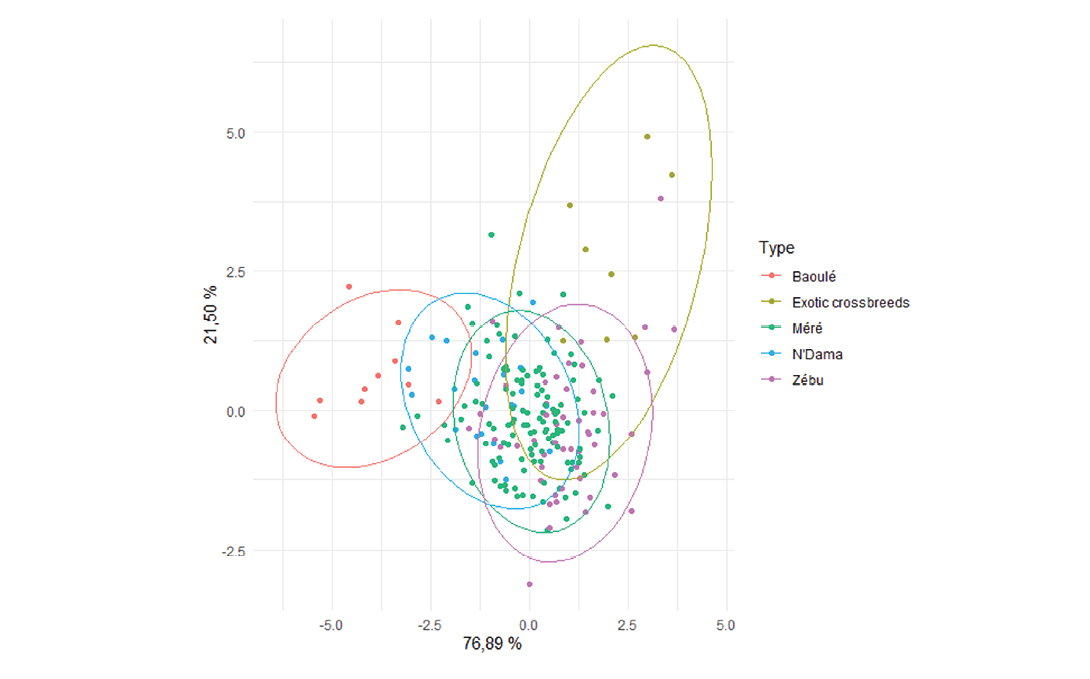
The projection of individual animals onto the canonical discriminant plane (Figure 4) illustrates the morphological relationships among the genetic types. This projection reveals a clear separation of Zebu cattle from Baoulé taurines on one side and from exotic crossbreds on the other. Nonetheless, individuals belonging to the Méré, N’Dama, and Zebu groups showed some degree of overlap.
In terms of morphological similarity and divergence, Mahalanobis distances (Table 6) indicated that all genetic types were significantly different from one another (p < 0.05). The greatest morphological dissimilarity was observed between Baoulé taurines and exotic crossbreds (distance = 41.25), while the closest genetic types were Méré, Zebu, and N’Dama (Table 6).
Table 6. Mahalanobis distance matrix between cattle types. *, significant distance at 5% threshold; **, significant distance at 1% threshold.
|
Baoulé |
Méré |
Exotic crossbreeds |
N’Dama |
Zebu |
|
|
Baoulé |
0 |
||||
|
Méré |
16.663** |
0 |
|||
|
Exotic crossbreeds |
41.248** |
12.878** |
0 |
||
|
N’Dama |
9.093** |
1,187* |
16.129** |
0 |
|
|
Zebu |
25.186** |
1.042** |
10.675** |
4.264** |
0 |
Classification of the cow population
Linear discriminant analysis showed that farmers correctly identified 65.24% of the animals according to their genetic type. The proportions of correctly classified individuals are presented along the main diagonal of Table 7. Animals of the Baoulé and Méré genetic types were accurately identified in 90% and 89.74% of cases, respectively. Nevertheless, a small proportion of these two genetic types exhibited morphological similarities with Zebu (6.84%) and N'Dama (1.71%) breeds. Among exotic crossbreds, 25% were misclassified as Zebu based on their morphological traits. Only 8.33% of N'Dama individuals were correctly classified, while 83.33% were reclassified as Méré. For Zebu cattle, 31.37% were correctly identified, whereas 68.62% were misclassified, most of these being reassigned to Méré (62.74%) and a smaller proportion to exotic crossbreds (5.88%).
Table 7. Percentage (%) of animals correctly or incorrectly classified.
|
Predicted populations |
|||||
|
Observed populations |
Baoulé |
Méré |
Exotic crossbreeds |
N’Dama |
Zebu |
|
Baoulé |
90 |
0 |
0 |
10 |
0 |
|
Méré |
1.71 |
89,74 |
0 |
1.71 |
6.84 |
|
Exotic crossbreeds |
0 |
12.5 |
62.50 |
0 |
25 |
|
N’Dama |
8.33 |
83.33 |
0 |
8.33 |
0 |
|
Zebu |
0 |
62.74 |
5.88 |
0 |
31.37 |
|
Proportion of cattle incorrectly classified |
10 |
10.26 |
37.5 |
91.66 |
68.62 |
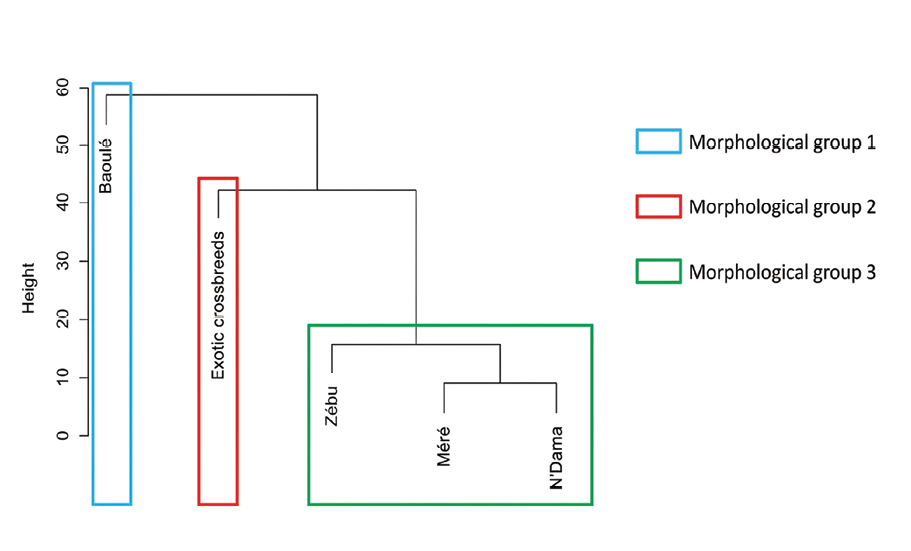
The dendrogram constructed from Mahalanobis distances among genetic types revealed two major clusters: one composed of Baoulé taurines, and the other comprising all remaining genetic types. This latter group was further subdivided into three morphologically homogeneous subgroups corresponding to the main genetic types (Figure 5). In addition to the Baoulé taurine subgroup, the analysis distinguished a subgroup consisting of exotic crossbreds and another formed by Zebu cattle together with the intermingled Méré and N'Dama taurines.
Discussion
The physical description based on qualitative traits shows that, except the hump found in the Méré and Zebu breeds, qualitative characteristics do not allow for the distinction of the different genetic types of cattle found in northern Côte d’Ivoire. The presence of a hump in the Zebu breed is linked to its environment. In fact, the Peulh Zebu raised in Côte d’Ivoire originates from the Sahel countries bordering Côte d’Ivoire. In this environment characterized by intense heat, the fat-filled hump acts as a water reservoir for cattle in this region. The distinction between Zebu and Méré breeds and Taurine breeds was also highlighted by Ndiaye et al (2014) in the cattle population of Senegal. This characteristic enabled Houessou et al (2019) to distinguish the Boboji and Somba Taurine breeds from Zebu breeds among cattle raised in extensive production systems in Benin. The various coat patterns observed are thought to be the result of preferential selection by pastoralist communities in favour of animals with varied coat patterns, combined with uncontrolled mating (Terefe et al, 2015). The different patterns found in this study were also reported by Belay & Zeleke (2021) in indigenous cattle in Sidama, Ethiopia, and by Banjaw et al (2025) in cattle from southeastern Ethiopia. The six different coat colours observed in the population highlight a high degree of variability. Coat colour diversity was also documented by Gelaye et al (2022) and Belay & Zeleke (2021). Within each breed, the heterogeneity in coat colouration suggests the presence of several ecotypes, which could be confirmed by molecular studies (Gelaye et al, 2022). The light colours, such as white, gray, and fawn, observed in each population appear to reflect a preference among herders in their choice of animals. Indeed, according to Alebachew (2017), coat colour is a criterion for selecting and identifying cattle in most pastoral communities. Light colours are preferred because they are well-suited to hot regions such as our study area. Indeed, light colours allow animals to dissipate their body heat more effectively than dark coats, which absorb heat more readily and are therefore better suited to cold regions (Titto et al, 2016; Gebru et al, 2017). In this study, coat colour and pattern are not used as criteria for distinguishing between different breeds. Similarities in coat colour and pattern were also highlighted by Mustefa et al (2021) and Banjaw et al (2025) among cattle breeds in northern and southern Ethiopia, respectively. These similarities indicate a phenotypic resemblance among the different breeds. This resemblance suggests a genetic relationship (Banjaw et al, 2025). In addition to the similarities observed in coat colour, other similarities were noted. Furthermore, the resemblances in other phenotypic traits, including the forehead spot, black markings, pigmentation of the eyelids and muzzle, and the dorsal line, highlight the difficulty of classifying these individuals by breed. The wide variability observed in traits such as coat colour and horn shape may be explained more by farmers’ preferences than by the classification of an individual into a specific breed (Traoré et al, 2015). Overall, these results show that qualitative traits do not provide a sufficiently effective description of cattle breeds or the different genetic types of cattle. They corroborate the observations of Traoré et al (2016), according to whom the characterization of West African cattle populations is not based on the same criteria as that of European cattle, for which qualitative traits play a decisive role in the identification and registration of individuals in pedigree records.
Morphometric traits
Quantitative traits are of paramount importance because they are directly linked to animal productivity, which has economic significance. All quantitative variables showed significant differences among the cattle types, confirming notable differences in shape and size among the five cattle types. Genetic factors may cause these differences. Indeed, according to Ahmed et al (2021), morphological differences among adult cattle may be caused by genetic factors. The morphological differences observed among different cattle breeds were also reported by Ndiaye et al (2014) for N’Dama, Zebu (Gobra and Maure), and Djakoré cattle raised in various production systems in Senegal, and by Okoh et al (2025) among four Zebu breeds: White Fulani, Gudali, Azawak, and Bororo. Similarly, Yougbaré et al (2020) identified significant differences in size between purebred Baoulé cattle in Burkina Faso and their crossbreeds. These observations corroborate the findings of Traoré et al (2015), who demonstrated the existence of marked differences in most body measurements among West African cattle. According to Yakubu et al (2012), each genetic type has a specific morphology that reflects its quantitative morphological structure and its adaptation to the environmental conditions to which it is subjected. Thus, the superior performance observed in exotic crossbreeds for most of the measured parameters could be attributed to their degree of genetic introgression of exotic origin. This superior performance can be attributed to the fact that, unlike local breeds, whose gene pool remains relatively heterogeneous and has not undergone targeted selection, exotic breeds have been selectively bred through genetic improvement programmes aimed at enhancing zootechnical performance, particularly growth rate. Furthermore, these breeds often have larger body measurements than local breeds, reflecting their selection for increased milk and meat production (Carneiro et al, 2010). The differences observed between Zebu and taurine breeds (N’Dama and Baoulé) could be explained, on the one hand, by independent domestication events and, on the other hand, by breed-specific characteristics of these cattle populations (Traoré et al, 2016). Native West African cattle are generally characterized by their relatively small body size, whereas Zebu cattle, which are distinguished by the presence of a hump, are typically larger (Traoré et al, 2015). The taurine N’Dama in this study showed slightly higher average measurements than those of N’Dama in Senegal, as reported by Kanh (2020). That author showed that N’Dama cattle from Senegal had a withers height of 105.9 ± 4.77cm; a body length of 115.43 ± 7.95cm; and a tail length of 77.28 ± 7.28cm. With regard to the head, in addition to horn length, for which the N’Dama cattle of Senegal had the highest values, the N’Dama cattle in our study recorded the highest averages. Furthermore, the averages recorded for N’Dama cattle were higher than those of the humpless cattle populations of Togo, as reported by Boma et al (2018). These authors reported average heights at the withers ranging from 97.2 ± 4.7cm for Kouka cattle to 99.4 ± 3.7cm for Tém cattle. As for Baoulé cattle, the body measurements are essentially identical to those reported by (Soro et al, 2015b) in the Pays Lobi region of Côte d’Ivoire. However, these cattle exhibited higher average measurements than the Lobi cattle of Burkina Faso, according to the findings of Tapsoba et al (2020). The mean values recorded for Méré-type cattle, which fall between those of Zebu and N'Dama cattle, are consistent with their hybrid origin resulting from crossbreeding between these two breeds. These results are consistent with those of Sokouri et al (2007), who stated that the Méré cattle are traditionally described as the offspring of crosses between Zebu and Baoulé taurine cattle; our findings suggest that some individuals may instead result from crossbreeding between Zebu and N'Dama cattle. They also confirm that crossbreeding between taurine cattle and Zebu generally leads to an increase in the size of the animals, a trait often considered advantageous by breeders (Yougbaré et al, 2020). Furthermore, the resemblance of Méré-type cattle to N'Dama bulls with respect to chest circumference, body length, and tail length suggests that N'Dama cattle contribute these morphological characteristics to their hybrid offspring produced through crossbreeding with Zebu cattle. Moreover, the similarities observed between the Méré and the Zebu in terms of certain head parameters would indicate a more pronounced influence of Zebu ancestry on the head dimensions of the descendants that gave rise to the Méré cattle breed. Finally, the similarities observed between N'Dama and Baoulé cattle in certain morphological traits, particularly horn spacing and ear length, suggest that these characteristics are relatively conserved within the Bos taurus subspecies.
Multivariate analysis
Stepwise discriminant analysis identified withers height, head length, ear length, and muzzle circumference as the morphometric traits that most effectively discriminate among the different cattle genetic types. These results suggest that taking these traits into account may be sufficient to distinguish between the different types of cattle raised on farms in northern Côte d’Ivoire, without the need for additional morphometric measurements. Similar to the study conducted by Lombebo & Zeleke (2018) on indigenous cattle populations in southern Ethiopia. The results of the present study further showed that pelvic width, chest circumference, hock circumference, height at the withers, and muzzle circumference were among the most informative morphometric traits for discriminating among cattle populations. These results contradict those of Sokouri et al (2007), who identified, in addition to the presence or absence of a hump and coat colour, only two quantitative traits, namely chest circumference and height at the withers, for distinguishing these five genetic types of cattle. This difference may be due to the number of variables selected for the discriminant analysis. Indeed, according to Okoh et al (2025), the number of discriminant variables is highly dependent on the number of variables included in the discriminant analysis.
The high canonical correlation values (> 50%) obtained from canonical discriminant analysis (CDA) suggest that the selected variables have strong discriminant power and thus allow for effective characterization of the animals. Previous studies have also reported strong canonical correlations, including the work by Okoh et al (2025) on the characterization of four Zebu breeds in Nigeria and that by Banjaw et al (2025) on indigenous breeds in southern Ethiopia. Concerning eigenvalues, a value greater than 1 is generally considered a criterion for validating discrimination between races. However, although this threshold allows an eigenvalue to be considered significant, higher values indicate greater discriminatory power and, consequently, better differentiation between groups. Thus, in this study, despite a Can1 eigenvalue greater than 1, little differentiation between breeds was observed, as evidenced by the overlaps shown in Figure 3. These overlaps highlight a strong phenotypic similarity among the five cattle breeds or genetic types studied. These results suggest that distinguishing between the different breeds that make up the Ivorian cattle population based on visual observation alone remains particularly difficult (Yakubu et al, 2012). These results confirm the already well-documented problem of identifying cattle breeds in Côte d’Ivoire based exclusively on their phenotypic characteristics (Sokouri et al, 2007; N’Goran et al, 2008; N’Goran, 2010; N’Goran et al, 2018). This difficulty in distinguishing between breeds reflects the challenges associated with identifying patterns of genetic variation within West African cattle populations (Álvarez et al, 2014). According to these authors, this situation is due to the absence of selection and to gene flow resulting from transhumance and the trade in live animals in West African regions. Furthermore, Yakubu & Ibrahim (2011) have shown that transhumance is a factor in gene exchange between cattle populations. Consequently, this study shows that canonical discriminant analysis (CDA), based on body measurements, did not allow for sufficiently effective discrimination between the different genetic types of cattle. These findings are consistent with those of Okoh et al (2025), who also found that CDA failed to effectively differentiate between the White Fulani and Red Bororo cattle breeds in Nigeria. However, other studies have demonstrated the effectiveness of this approach in distinguishing between cattle breeds. This is particularly true of the work by Mustefa et al (2023) on the Harar and Ogaden breeds in eastern Ethiopia, that of Ahmed et al (2021) on the White Fulani, Muturu, and Pasundan breeds, and the work by Zegeye et al (2021) on five local cattle breeds in Tigray, northern Ethiopia. The high Mahalanobis distance observed between the Baoulé cattle and the exotic crossbreeds indicates that these two types of cattle constitute morphologically distinct populations. In contrast, the low distances recorded between the N’Dama, Zebu, and Méré populations suggest the existence of significant morphological similarities among these different groups. These similarities could also be explained by the proximity and frequent coexistence of these three genetic types within cattle herds in Côte d’Ivoire. Indeed, Yao et al (2025) reported that cattle herds in northern Côte d’Ivoire consist mainly of Méré-type cattle, followed by Zebu, with a smaller proportion of N’Dama taurine cattle. This configuration promotes crossbreeding among these three genetic types due to their proximity within livestock production systems. This situation could be explained by breeders’ desire to meet the requirements of livestock marketing systems, particularly by seeking animals with better zootechnical performance and greater market value (Whannou et al, 2021). However, these phenotypic similarities do not necessarily imply genetic similarities (Mustefa et al, 2021; 2022). Consequently, it would be advisable to conduct additional studies using molecular techniques to better understand the level of genetic diversity within and between breeds (Mustefa et al, 2023).
The high percentage of Baoulé Taurin cattle classified within their group of origin demonstrates that the Baoulé Taurin constitutes a homogeneous population with specific morphological characteristics that are well recognized by breeders. This stability of the breed is believed to be linked to the sociocultural motivations of the herders in the Pays Lobi, which lead them to preserve this Baoulé cattle breed (Soro et al, 2015a). The low percentage of N’Dama taurines reclassified highlights a high level of heterogeneity within this population. This high level of heterogeneity is believed to be linked to its range in Côte d’Ivoire (North), which serves as a hub for all other breeds engaged in transhumance. This consequently exposes the breed to crossbreeding with these introduced breeds, particularly with the Zebu. In fact, according to Sokouri et al (2009), the frequency of crossbreeding is higher in areas where Zebu (on transhumance) come into contact with Taurine breeds. This would explain the high level of crossbreeding among Taurine breeds observed on farms in northern Côte d’Ivoire, as reported by (Sokouri et al, 2007). The morphological variability within the N’Dama population also reflects the significant role that breeders play in crossbreeding. Uncontrolled crossbreeding poses a real threat to the survival, conservation, and long-term use of these breeds (Houessou et al, 2019).
Conclusion
The present study highlighted the morphological variability of cattle breeds raised in the northern regions of Côte d’Ivoire. Among the 14 body parameters measured, withers height emerged as the descriptor that best allows differentiation between the breeds. Despite the morphological differences observed among these breeds, the analyses did not allow for their complete separation. Except for the Baoulé taurines, which are clearly distinct, the N’Dama and Zebu breeds and the Méré type share several morphological similarities, making them difficult to distinguish. The overlaps observed among the different breeds reflect a high level of gene flow between these populations. This study also shows that the Méré constitutes a homogeneous population in the breeding regions, while the N’Dama taurine is experiencing a loss of its characteristic traits. These results confirm the hypothesis that the genetic structure of the Ivorian cattle population is highly mixed, with a risk of erosion of local taurine breeds. Given these findings, molecular analysis is essential to clarify the genetic status of each breed.
Author contributions
FADY: conceptualization, investigation, writing – original draft, formal analysis, data curation and methodology. JYE: methodology, writing – review & editing and translation. KHMK: investigation, formal analysis and writing – review & editing. NEL: writing – review & editing. AMDA: investigation. AK: resources. BT: resources. MK: resources. ZAAB: investigation. EB: resources. KEN: conceptualization, methodology, funding acquisition, supervision, writing – review & editing, project administration and validation.
Acknowledgements
This study was supported by the IAEA–Côte d’Ivoire Technical Cooperation Project No. IVC2020004, entitled “Improving the Productivity of Local Livestock through Molecular Biology Techniques.”
The authors sincerely thank the regional and departmental offices of the Ministry of Animal and Fisheries Resources (MIRAH) and the farmers for their assistance and collaboration during the data collection for this study.
Conflict of interest
The authors declare that they have no conflicts of interest regarding this article.
Ethics statement
No laboratory animals were used in this work. The authors have nothing to report.
References
Ahmed, R. O., Putra, W. P. B., Arifin, J., & Bello, S. F. (2021). Morphometrics characterization in White Fulani, Muturu and Pasundan cows. Livestock and Animal Research, 19(3), 319. https://doi.org/10.20961/lar.v19i3.51661
Ahozonlin, M.C., Dossa, L.H., Dahouda M. & Gbangboche A.B. (2019). Morphological divergence in the West African shorthorn Lagune cattle populations from Benin. Tropical Animal Health and Production; 52(2): 803 – 814. https://doi.org/10.1007/s11250-019-02071-1
Alebachew, H. (2017). On-Farm Phenotypic Characterization, Husbandry and Breeding Practices of Indigenous Cattle Breed in Selected Areas of Benishangul-Gumuz, Western Ethiopia.
Álvarez I, Traoré A, Fernández I, Cuervo M, Lecomte T, Soudré A, Kaboré A, Tamboura H H and Goyache F. (٢٠١٤). Assessing introgression of Sahelian zebu genes into native Bos taurus breeds in Burkina Faso. Molecular Biology Reports 41(6): 3745-3754. https://doi.org/10.1007/s11033-014-3239-x
Banjaw, B., Didanna, H. L., & Mustefa, A. (2025). Phenotypic characterization of cattle breeds in Southern Ethiopia : Implications for breed differentiation and conservation. Genetic Resources, 6(11), 71-81. https://doi.org/10.46265/genresj.SCLC1551
Belay, D. L., & Zeleke, B. (2021). On-Farm Phenotypic Characterization of Indigenous Cattle in its Production Environment in Sidama, Ethiopia.
Boma, S., Nuto, Y., Dayo, G.-K., Bonfoh, B., & N’Feide, T. (2018). Caractérisation morpho-biométrique des populations bovines locales sans bosse du Togo. International Journal of Biological and Chemical Sciences, 12(1), 431. https://doi.org/10.4314/ijbcs.v12i1.34
Carneiro, H., Louvandini, H., Paiva, S. R., Macedo, F., Mernies, B., & McManus, C. (2010). Morphological characterization of sheep breeds in Brazil, Uruguay and Colombia. Small Ruminant Research, 94(1-3), 58-65. https://doi.org/10.1016/j.smallrumres.2010.07.001
Cesaro J-D and Apolloni A. (2020). Élevage et urbanité, dans les villes développées ou en développement, quelles oppositions et quelles complémentarités ? Territoire en mouvement Revue de Géographie et aménagement 44-45: 1-19. https://doi.org/10.4000/tem.6131
FAO. (2005). AQUASTAT Profil de Pays – Côte D’Ivoire. Organisation des Nations Unies pour l’alimentation et l’agriculture. https://openknowledge.fao.org/handle/20.500.14283/i9921fr
FAO. (2012). Phenotypic characterization of animal genetic resources. Food and Agriculture Organization of the United Nations. https://openknowledge.fao.org/handle/20.500.14283/i2686e
Gebru, T., Yigrem, S., & Banerjee, S. (2017). Some morphometrical, production and reproduction traits of Begait cattle reared in Tigray region of Ethiopia. Wayamba Journal of Animal Science, 1571-1585.
Gelaye, G., Baye, M., Masho, W., Begna, R., & Admasu, Z. (2022). Morphometric traits and structural indices of indigenous cattle reared in Bench Sheko zone, southwestern Ethiopia. Heliyon, 8(8), e10188. https://doi.org/10.1016/j.heliyon.2022.e10188
Houessou S O, Dossa L H, Diogo R V C, Ahozonlin M C, Dahouda M and Schlecht E. (2019). Confronting pastoralists’ knowledge of cattle breeds raised in the extensive production systems of Benin with multivariate analyses of morphological traits. PLOS ONE 14(9): 1-19. https://doi.org/10.1371/journal.pone.0222756
INS. (2022). Récensement générale de la population et de l’habitat 2021 : Résultats glogaux (p. 37). Ministère du Plan et du Développement. https://plan.gouv.ci/uploads/publications/RGPH2021-RESULTATS-GLOBAUX-VF.pdf
Kanh, K. H. M. (2020). Caractérisation des systèmes d’élevage et des populations de bovins N’Dama des régions de Kolda et de Ziguinchor (Sénégal). PhD Thesis. Université Félix Houphouët-Boigny, Abidjan, Côte d'Ivoire.
Kassambara, A., & Mundt, F. (2020). factoextra : Extract and Visualize the Results of Multivariate Data Analyses (Version 1.0.7). http://www.sthda.com/english/rpkgs/factoextra
Kouamé A C, Kouadja G S, Kouadio K E, Toure P, Bamba, K L and Kreman K. (2024). Caractéristiques socio-démographiques et techniques des systèmes d’élevage de ruminants et analyse des contraintes de production en Côte d’Ivoire. Revue Marocaine des Sciences Agronomiques et Vétérinaires 12(3): 149-157. https://doi.org/10.5281/zenodo.13711002
Lenth, R., & Piaskowski, J. (2026). Emmeans : Estimated Marginal Means, aka Least-Squares Means. R package (Version 2.0.5). https://rvlenth.github.io/emmeans/
Lombebo, W. A., & Zeleke, N. A. (2018). On Farm Phenotypic Characterization of Local Cattle Populations in Hadiya Zone, Southern Region, Ethiopia. Advances in Dairy Research, 06(04), 1-8. https://doi.org/10.4172/2329-888X.1000218
MIRAH. (2022). Politique nationale de développement de l’élevage, de la pêche et l’aquaculure (PONADEPA 2022-2026). https://faolex.fao.org/docs/pdf/ivc209419.pdf (accessed on 12 October 2025)
Mustefa, A., Aseged, T., Sinkie, S., Getachew, F., Fekensa, T., Misganaw, M., & Hailu, A. (2023). Phenotypic characterization of Harar and Ogaden cattle breeds of Ethiopia : The first step for conservation. Genetic Resources, 4(7), 56-67. https://doi.org/10.46265/genresj.IXPJ9541
Mustefa, A., Belayhun, T., Melak, A., Hayelom, M., Tadesse, D., Hailu, A., & Assefa, A. (2021). Phenotypic characterization of Raya cattle in northern Ethiopia. Tropical Animal Health and Production, 53(1), 48. https://doi.org/10.1007/s11250-020-02486-1
Mustefa, A., Engdawork, A., Sinke, S., & Hailu, A. (2022). Phenotypic characterization of Gesha horses in southwestern Ethiopia. Genetic Resources, 3(5), 36-50. https://doi.org/10.46265/genresj.KPIL8781
Naves M, Alexandre G, Mahieu M, Gourdine J-L and Mandonnet N. (2011). Les races animales locales : Bases du développement innovant et durable de l’élevage aux Antilles. Innovations Agronomiques 16: 193-205. https://doi.org/10.17180/awhs-nv51
Ndiaye N P, Sow A, Ndiaye S, Sembene M and Sawadogo G J. (2014). Phenotypical Characterization of Senegalese Local Cattle Breeds Using Multivariate Analysis. Journal of Animal and Veterinary Advances 13(20): 1150-1159. https://doi.org/javaa.2014.1150.1159
N’Goran E K, Sokouri D P, Gnaore C V and Fantodji A T. (2015). Croisement de la race n’dama avec les races abondance et montbéliarde en zone tropicale humide de Côte d'Ivoire : Caractérisation phénotypique et analyse comparative des croisés pour leurs performances laitières en ferme. Agronomie Africaine 27(1): 15-26.
N’Goran K E. (2010). Caractérisation phénotypique et aptitudes laitières du cheptel bovin laitier dans les régions Centre, Centre-Ouest et Sud de la Côte d’Ivoire. PhD diss., Université Abobo-Adjamé, Abidjan, Côte d'Ivoire.
N’Goran K E, Bamba L K, Kouassi N C, Loukou N E, Dayo G-K, Sangare M and Yapi-Gnaoré C V. (2018). Multivariate Analysis for Morphological Characteristics of N’Dama Cattle Breed in Two Agro-ecological Zones of Côte d’Ivoire. European Scientific Journal 14(3): 602-621. https://doi.org/10.19044/esj.2018.v14n3p602
N’Goran K E, Yapi-Gnaoré C V, Fantodji A and N’Goran A. (2008). Caractérisation phénotypique et performances des vaches laitières de trois régions de Côte d'Ivoire. Archivos de zootecnia 57(220): 415-426.
Okoh, J. J., Putra, W. P. B., Ibrahim, Y., Maigado, A., Ibrahim, S., Ma’aruf, B. S., Shuaibu, A., Adakole, J. P., & Harahap, R. S. (2025). Canonical and hierarchical analyses of body measurements in four Nigerian cattle breeds under an extensive management system. Tropical Animal Health and Production, 57(8), 487. https://doi.org/10.1007/s11250-025-04644-9
R Core Team. (2024). R: A Language and Environment for Statistical Computing. R Foundation for Statistical Computing. (Version 4.4.2). https://www.r-project.org/
Sokouri D P, Loukou N E, Yapi-Gnaoré C V, Mondeil, F and Gnangbe F. (2007). Caractérisation phénotypique des bovins à viande (Bos taurus et Bos indicus) au centre (Bouaké) et au nord (Korhogo) de la Côte d’Ivoire. Animal Genetic Resources Information 40: 43-53. https://doi.org/10.1017/S1014233900002182
Sokouri D P, Yapi-Gnaore C V, N’Guetta A S P, Loukou N E, Kouao B J, Toure G and Sangare A. (2009). Utilisation et gestion des races taurines locales sous la pression des croisements avec les zébus dans les régions Centre et Nord de la Côte d’Ivoire. Journal of Animal & Plant Sciences 5(2): 456-465.
Soro B, Sokouri D P, Dayo G-K, N’Guetta A S P and Yapi-Gnaoré C V. (2015a). Caractérisation des bovins de race Baoulé dans le ''Pays Lobi” de Côte d’Ivoire : Rôles socioéconomiques, modes d’élevage et contraintes de production. TROPICULTURA 33(2): 111-124.
Soro B, Sokouri D P, Dayo G-K, N’Guetta A S P and Yapi-Gnaore C V. (2015b). Morphometric and physical characteristics of Baoulé cattle in the « Pays Lobi » of Côte d’Ivoire. Livestock Research for Rural Development 27(7): 1-11.
Tapsoba, A. S. R., Yougbaré, B., Traoré, F. G., Béré, F., Ouédraogo, D., Zoma, B. L., Sanou, M., Soudré, A., Dao, V., Tamboura, H. H., Bayala, B., Traoré, A., & Goyache, F. (2020). Temporal variation in body measurements in three Taurine cattle populations of Burkina Faso supports introgression of Zebu genes into West African Taurine cattle. International Journal of Biological and Chemical Sciences, 14(8), 2782-2798. https://doi.org/10.4314/ijbcs.v14i8.11
Terefe, E., Haile, A., Mulatu, W., Dessie, T., & Mwai, O. (2015). Phenotypic characteristics and trypanosome prevalence of Mursi cattle breed in the Bodi and Mursi districts of South Omo Zone, southwest Ethiopia. Tropical Animal Health and Production, 47(3), 485-493. https://doi.org/10.1007/s11250-014-0746-7
Titto, C. G., Veríssimo, C. J., Pereira, A. M. F., Geraldo, A. de M., Katiki, L. M., & Titto, E. A. L. (2016). Thermoregulatory response in hair sheep and shorn wool sheep. Small Ruminant Research, 144, 341-345. https://doi.org/10.1016/j.smallrumres.2016.10.015
Traoré, A., Koudandé, D. O., Fernández, I., Soudré, A., Álvarez, I., Diarra, S., Diarra, F., Kaboré, A., Sanou, M., Tamboura, H. H., & Goyache, F. (2016). Multivariate characterization of morphological traits in West African cattlesires. Archives Animal Breeding, 59(3), 337-344. https://doi.org/10.5194/aab-59-337-2016
Traoré, A., Koudandé, D. O., Fernández, I., Soudré, A., Granda, V., Álvarez, I., Diarra, S., Diarra, F., Kaboré, A., Sanou, M., Tamboura, H. H., & Goyache, F. (2015). Geographical assessment of body measurements and qualitative traits in West African cattle. Tropical Animal Health and Production, 47(8), 1505-1513. https://doi.org/10.1007/s11250-015-0891-7
Venables, W., & Ripley, B. (2002). Modern Applied Statistics with S, Fourth edition. Springer US. https://doi.org/https://doi.org/10.1007/978-0-387-21706-2
Whannou, H. R. V., Afatondji, C. U., Ahozonlin, M. C., Spanoghe, M., Lanterbecq, D., Demblon, D., Houinato, M. R. B., & Dossa, L. H. (2021). Morphological variability within the indigenous sheep population of Benin. PLOS ONE, 16(10), e0258761. https://doi.org/10.1371/journal.pone.0258761
Yakubu A and Ibrahim I A. (2011). Multivariate analysis of morphostructural characteristics in Nigerian indigenous sheep. Italian Journal of Animal Science 10(2): 83-86. https://doi.org/10.4081/ijas.2011.e17
Yakubu, A., Peters, S. O., Ilori, B. M., Imumorin, I. G., Adeleke, M. A., Takeet, M. I., Ozoje, M. O., Ikeobi, C. O. N., & Adebambo, O. A. (2012). Multifactorial discriminant analysis of morphological and heat-tolerant traits in indigenous, exotic and cross-bred turkeys in Nigeria. Animal Genetic Resources/Ressources Génétiques Animales/Recursos Genéticos Animales, 50, 21-27. https://doi.org/10.1017/S2078633611000610
Yao, F. A. D., N’Goran, K. E., Ekra, J.-Y., Kanh, K. H. M., Tre, U. B., Konaté, A., Sonan, H., Diloreto, E., & Mafie, E. M. (2025). Characterization and Typology Analysis of Cattle Breeding Practices on Rural Farms in Northern Côte d’Ivoire. Tropical Animal Science Journal, 48(5), 471-480. https://doi.org/10.5398/tasj.2025.48.5.471
Yapi-Gnaore C V, Oya B A and Ouattara Z. (1996). Revue de la situation des races d’animaux domestiques de Côte d’Ivoire. Animal Genetic Resources Information 19: 91-108. https://doi.org/10.1017/S101423390000081X
Yougbaré, B., Soudré, A., Ouédraogo, D., Zoma, B. L., Tapsoba, A. S. R., Sanou, M., Ouédraogo-Koné, S., Burger, P., Wurzinger, M., Khayatzadeh, N., Tamboura, H. H., Traoré, A., Sölkner, J., & Mészáros, G. (2020). Morphometric characterization of purebred and crossbred Baoulé cattle in Burkina Faso. Acta Agriculturae Scandinavica, Section A — Animal Science, 69(4), 193-202. https://doi.org/10.1080/09064702.2020.1825785
Zegeye, T., Belay, G., & Hanotte, O. (2021). Multivariate characterization of phenotypic traits of five native cattle populations from Tigray, Northern Ethiopia. Tropical Animal Health and Production, 53(2), 212. https://doi.org/10.1007/s11250-021-02652-z