Implementing safety duplication of Malaysian crop germplasm at the Svalbard Global Seed Vault: Workflow, outcomes and lessons learned
Muhammad Shafie Md Saha,*, Mohd Ramdzan Othmanb, Muhammed Nazmi Lahamc,
Nur Idayu Abd Rahimb, Mohd Norfaizal Ghazallia, Mohd Saifuddin Ismaila
a Agrobiodiversity and Environment Research Centre, MARDI Headquarters, Persiaran MARDI-UPM, 43400 Serdang, Selangor, Malaysia
b MARDI Station Seberang Perai, Locked Bag No. 203, Kepala Batas Post Office, 13200 Seberang Perai, Pulau Pinang, Malaysia
c MARDI Station Jerangau, 21820 Ajil, Terengganu, Malaysia
* Corresponding author: Muhammad Shafie Md Sah (shafiems@mardi.gov.my)
Abstract: Conserving plant genetic resources for food and agriculture is essential for agricultural resilience and long-term food security. Safety duplication – the storage of duplicate seed samples in geographically separate facilities – is essential for genebank quality management and for safeguarding valuable germplasm against catastrophic loss. This study presents Malaysia's first national safety duplication initiative to the Svalbard Global Seed Vault (Seed Vault), describing operational processes, selection criteria and lessons learned. A total of 774 accessions of traditional rice (Oryza sativa) and its wild relatives (O. officinalis, O. rufipogon, O. meyeriana and O. ridleyi), traditional varieties of eggplant and its wild relatives (Solanum spp.) and cowpea (Vigna unguiculata) maintained by the Malaysian Agricultural Research and Development Institute (MARDI) were evaluated for duplication. Candidate accessions underwent germination testing, regeneration, seed processing, quality assurance and documentation following FAO Genebank Standards and Seed Vault depositor requirements. After regeneration and quality assessment, 725 accessions (93.7%) satisfied the required standards and were deposited under the Seed Vault black-box storage arrangement. The initiative demonstrated that successful safety duplication extends beyond seed physical transfer and requires coordinated seed viability improvement, regeneration of ageing accessions, accurate documentation and adherence to internationally recognized conservation standards. The initiative provided a secure off-site backup for Malaysia's priority germplasm collections and supported routine genebank management by renewing seed stocks, improving documentation and strengthening long-term conservation capacity. The phased implementation described here provides a practical model for national genebanks seeking to establish or expand safety duplication programmes while contributing to global efforts to safeguard crop genetic diversity.
Keywords: Safety duplication, Seed conservation, Svalbard Global Seed Vault, food security, PGRFA, genebank management
Introduction
Plant genetic resources for food and agriculture (PGRFA) underpin global food systems and agricultural sustainability, as recognized in the preamble of the International Treaty on Plant Genetic Resources for Food and Agriculture (ITPGRFA), which emphasizes their fundamental role in achieving food security and sustainable agriculture. The diversity found in traditional crops and crop wild relatives offers valuable traits for crop improvement, including resistance to pests and diseases, tolerance to environmental stress and adaptability to changing climatic conditions (Khoury et al, 2022). Among the different conservation approaches, ex situ conservation through genebanks remains one of the most widely implemented strategies for safeguarding crop genetic diversity at national level. However, the effectiveness of ex situ conservation depends not only on appropriate storage conditions but also on comprehensive risk management strategies to safeguard collections against natural disasters, equipment failure, political instability and human error (Westengen et al, 2013). Previous studies also highlighted that numerous collections worldwide experience challenges related to ageing seed stocks, regeneration backlogs, financial and human resources limitations, incomplete documentation and uneven implementation of quality management practices (Khoury et al, 2022). These constraints may compromise the viability and availability of valuable germplasm if not addressed through systematic conservation and risk management strategies.
Recognizing these risks, the FAO Genebank Standards for Plant Genetic Resources for Food and Agriculture (FAO, 2014) recommend safety duplication as an essential component of quality management systems for orthodox seed collections. Safety duplicates should be stored at geographically separate facilities under comparable long-term conservation conditions to minimize the possibility of genetic loss. This practice ensures that valuable germplasm remains available even when the primary collection is damaged or inaccessible (FAO, 2014).
The Svalbard Global Seed Vault (Seed Vault) was established in 2008 as a global safety backup facility for orthodox seed, providing an additional layer of security for PGRFA maintained by national, regional and international genebanks (Asdal & Guarino, 2018). The facility is located in the Arctic Archipelago of Svalbard, a Norwegian territory, where naturally low temperatures and stable geological conditions provide favourable conditions for long-term seed storage. Over the past decade, the Seed Vault has been operated in partnership by the Norwegian Ministry of Agriculture and Food, the Nordic Genetic Resource Center (NordGen) and the Global Crop Diversity Trust (Crop Trust), becoming an important component of the global ex situ conservation infrastructure. Rather than replacing conventional genebanks, the Seed Vault functions as an additional layer of security within the global conservation system, supporting international efforts to secure crop diversity for future generations. The importance of this global backup system was demonstrated during the Syrian conflict, when the International Center for Agricultural Research in the Dry Areas (ICARDA) became the first institution to withdraw its own safety duplicates from the Seed Vault after losing access to its genebank in Aleppo. These safety duplicates allowed ICARDA to rebuild its active collections in Lebanon and Morocco and resume the distribution of germplasm, demonstrating the practical value of safety duplication in safeguarding crop diversity (Westengen et al, 2020). By the end of 2025, the Seed Vault held 1,378,238 seed samples deposited by 131 genebanks and institutions worldwide, following the addition of 46,781 safety duplicates during the year (NordGen, 2026). This upward trend has continued, with the Seed Vault's online Seed Portal (https://seedvault.nordgen.org/) currently recording more than 1.4 million seed samples (1,401,285) from 134 depositors, further reflecting the growing global participation in safety duplication.
Recent assessments further emphasize that effective safety duplication requires more than simply transferring seed samples. It depends on maintaining high seed quality, adequate viability, accurate documentation, regeneration of ageing accessions and compliance with internationally recognized genebank standards. These operational requirements often present significant challenges, particularly for national genebanks managing large collections with limited technical and financial resources (Engels & Ebert, 2021; Asdal, 2025).
In the Malaysian context, the conservation of PGRFA is primarily coordinated by the Malaysian Agricultural Research and Development Institute (MARDI). Major germplasm collections are maintained at MyGeneBank in MARDI Serdang, Selangor and the National Rice Genebank in MARDI Seberang Perai, Penang. Together, these facilities conserve more than 18,000 accessions representing both seed and field genebank collections. Approximately 15,000 accessions are orthodox seed species suitable for long-term seed storage and potential safety duplication, while the remaining field genebank collections comprise tropical fruit species, taro, tuber crops and yams that require alternative conservation strategies (Muhammad Shafie et al, 2020). MARDI joined global initiatives led by the Crop Trust under the ‘Biodiversity for Opportunities, Livelihoods and Development (BOLD)’ project and initiated a safety duplication programme involving selected traditional crop varieties and crop wild relatives for long-term conservation in the Seed Vault. Although many countries participate in the BOLD initiative, relatively few studies describe the practical processes, technical challenges and institutional experiences involved in preparing national collections for long-term safety backup. Sharing such experiences is important for improving genebank management practices and supporting other national programmes planning similar initiatives.
Despite the increasing global adoption of safety duplication, limited published evidence is available on how national genebanks evaluate accession readiness and implement the complete safety duplication process under international standards. This study presents a case study of Malaysia's first safety duplication of PGRFA from a national genebank to the Seed Vault, with the objectives of: (1) evaluating the readiness of candidate accessions for safety duplication based on internationally recognized genebank quality criteria, (2) describing the operational workflow and selection process, and (3) identifying lessons learned that may inform similar initiatives in other national genebanks.
Materials and methods
Selection of accession
Seed accessions selected for safety duplication were sourced from germplasm collections maintained by MARDI at the National Rice Genebank in MARDI Seberang Perai and MyGeneBank in MARDI Serdang. Candidate accessions were prioritized based on (1) availability of sufficient seed quantity, (2) inclusion in Annex I crops under the ITPGRFA, (3) seed viability status, and (4) regeneration priority based on seed age and storage history. The selected accessions comprised rice (Oryza spp.), eggplant (Solanum spp.), cowpea (Vigna unguiculata), and their respective wild relatives, all of which produce orthodox seeds and are listed in Annex I of the ITPGRFA. Several selected accessions represented ageing seed stocks that had remained in long-term storage for more than ten years without regeneration because of financial constraints and operational disruptions caused by the COVID-19 pandemic. Other accessions originated from early germplasm collecting missions undertaken during the establishment of MARDI's genebank programme, making their long-term security conservation through safety duplication particularly important.
Seed viability improvement
Candidate accessions were initially screened based on the criteria established for safety duplication. Initial seed viability was assessed through standard germination testing in accordance with the FAO Genebank Standards (FAO, 2014). Accessions requiring seed renewal were regenerated under field conditions to restore seed stocks and produce genetically representative, high-quality seed lots for long-term conservation. This included accessions with seed viability below 85%, many of which represented regeneration backlogs that had remained in long-term storage for more than ten years without regeneration. However, accessions with low initial viability frequently produced insufficient seed numbers and too few regenerated plants to maintain adequate genetic representation and were therefore excluded from safety duplication. Seeds were harvested at physiological maturity to ensure seed quality and longevity, followed by post-harvest seed processing and drying under genebank conditions. The harvested seeds were cleaned and air-dried overnight at room temperature before being transferred to a controlled drying room maintained at 15 ± 2°C and 35–40% relative humidity (RH) until the seed moisture content was reduced to below 10%, following MARDI’s genebank standard operating procedures. The dried seeds were subsequently processed and packaged before final viability testing. Regenerated seed lots were then subjected to a second germination test, and only those achieving germination percentages greater than 90% were approved for safety duplication in the Seed Vault. Accessions that did not meet the minimum requirements will undergo future regeneration and viability improvement before being reconsidered for subsequent safety duplication cycles.
Seed regeneration
Regeneration of rice, eggplant and cowpea accessions was conducted following the FAO Genebank Standards (FAO, 2014) and crop-specific regeneration guidelines developed by the International Rice Research Institute (IRRI), the World Vegetable Center and the International Institute of Tropical Agriculture (IITA), respectively. Species specific plot layouts and spatial isolation were employed to maintain accession identity and minimize pollen mediated gene flow during seed regeneration. Rice accessions were regenerated in six row plots with 20 plants per row, eggplant in four row plots with five plants per row, and cowpea in single-row plots with seven plants. Off type plants were removed prior to flowering and seeds were harvested at physiological maturity to preserve genetic integrity and avoid seed admixture. Plot configuration and field management followed the operational procedures of the MARDI genebank.
Seed processing and packaging
After harvest, seeds were cleaned manually to remove empty, immature and damaged seeds, followed by drying under controlled conditions until suitable for long-term conservation, as recommended by the FAO Genebank Standards. Seed moisture content and germination quality were assessed prior to storage. The majority of regenerated seed lots were retained in the MARDI’s genebank collection for medium-term and long-term conservation, while a representative duplicate sample (400–500 seeds) from the same seed lot was prepared for safety duplication in the Seed Vault. For each accession, the seeds were packed in hermetically sealed three-layer laminated aluminium foil bags in accordance with the Seed Vault depositor requirements (Svalbard Global Seed Vault, n.d.). Each package was labelled with the accession identity and crop species to ensure traceability throughout shipment and long-term safety conservation.
Shipment to the Svalbard Global Seed Vault
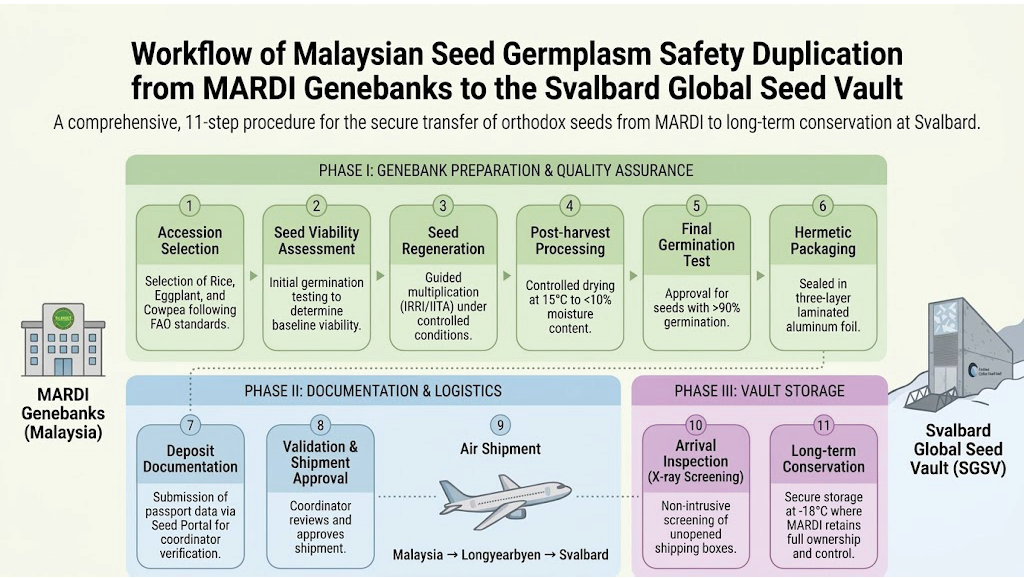
Prior to shipment, MARDI signed a Deposit Agreement with the Norwegian Ministry of Agriculture and Food, the owner of the Seed Vault, to fulfil the requirements governing the safety duplication of seed samples and prepared the required deposit documentation in accordance with the Seed Vault depositor guidelines. The accession list and associated passport information were submitted electronically to the Seed Vault coordinator, where the data underwent validation to verify the accuracy and completeness of accession information before shipment approval was granted and uploaded to the seed portal. Following validation, sealed seed packages were packed into shipping boxes and transported by air to Longyearbyen, Svalbard. Upon arrival, the unopened shipping boxes underwent X-ray security screening to confirm that they contained only sealed seed pouches. The boxes were then transferred directly into the Seed Vault long-term storage chambers maintained at −18 °C under the black-box storage arrangement, where ownership and control of the deposited materials remained with MARDI. Figure 1 summarizes the overall process of safety duplication of Malaysian germplasm from MARDI to the Seed Vault.
Results
A total of 774 accessions representing 11 taxa from three crop groups (rice, eggplant and cowpea) were initially screened for potential safety duplication to the Seed Vault as summarized in Table 1. Following evaluation against the established selection criteria, 725 accessions (93.7%) were considered suitable for duplication, while 49 accessions (6.3%) were excluded due to failure to meet the minimum seed quality requirements.
Table 1. Screening outcomes of candidate accessions for safety duplication at the Svalbard Global Seed Vault.
|
Species |
Screened |
Selected |
Not selected |
Reason for not selection |
|
Oryza sativa |
729 |
690 |
39 |
Low viability |
|
Oryza rufipogon |
1 |
1 |
0 |
– |
|
Oryza officinalis |
1 |
1 |
0 |
– |
|
Oryza meyeriana |
1 |
0 |
1 |
Low seed number |
|
Oryza ridleyi |
1 |
0 |
1 |
Low seed number |
|
Solanum melongena |
13 |
13 |
0 |
– |
|
Solanum xanthocarpum |
4 |
1 |
3 |
Low viability; low seed number |
|
Solanum cumingii |
4 |
2 |
2 |
Non-viable |
|
Solanum mammosum |
1 |
1 |
0 |
– |
|
Solanum capsicoides |
1 |
0 |
1 |
Non-viable |
|
Vigna unguiculata |
18 |
16 |
2 |
Low viability; low seed number |
|
Total |
774 |
725 |
49 |
Rice (Oryza spp.) constituted the largest proportion of the screened collection, with 733 accessions (729 of O. sativa and four wild rice). Of these, 692 accessions were selected for duplication, comprising 690 accessions of O. sativa together with O. rufipogon and O. officinalis. In contrast, O. meyeriana and O. ridleyi were not selected because of the insufficient number of seeds produced, while 39 accessions of O. sativa were excluded due to low seed viability.
Among the 23 accessions of eggplant (Solanum spp.) evaluated, 17 were selected including 13 of S. melongena, two S. cumingii, S. xanthocarpum and S. mammosum. The remaining six accessions were rejected because of either non-viable seeds or insufficient seed quantity. Specifically, three S. xanthocarpum had low seed number and low viability while two S. cumingii accessions and one S. capsicoides accession were excluded because of non-viable seeds. For cowpea (Vigna unguiculata), 18 accessions were screened and 16 fulfilled the requirements for safety duplication. The remaining two accessions were excluded because they exhibited both low seed viability and insufficient seed quantity.
The accessions included in this study represented a targeted subset of Malaysia's orthodox seed collection selected specifically for safety duplication under the BOLD initiative. Therefore, the 93.7% success rate reflects the outcome of the selection, regeneration and quality assurance process applied to these candidate accessions rather than the status of the entire national genebank collection. Nevertheless, the successful preparation and deposition of 725 accessions showed that a national genebank can meet international requirements for safety duplication through systematic implementation of FAO Genebank Standards. The selected accessions were deposited at the Seed Vault through two shipment events. The first shipment, comprising one box containing 207 seed pouches, was dispatched and deposited on 28 May 2024. The second shipment consisting of two boxes containing 518 seed pouches followed on 25 February 2025, completing Malaysia's first safety duplication programme with a total of 725 seed pouches deposited for long-term safety conservation. Figure 2 summarizes the timeline and workflow of the safety duplication process.
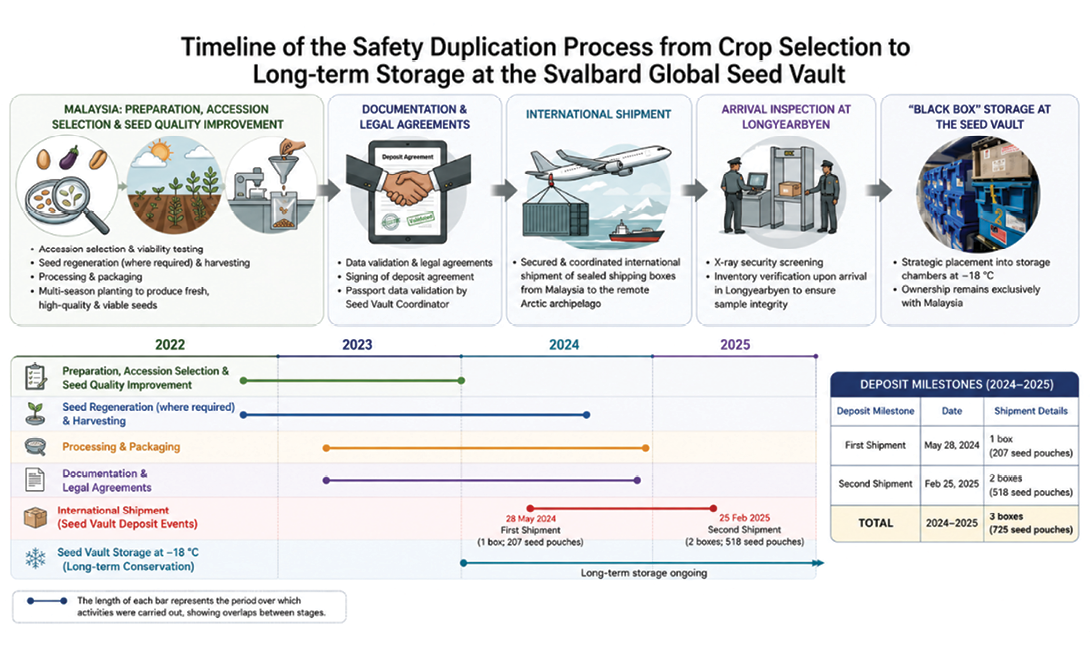
Figure 2. Workflow and implementation timeline of Malaysia's safety duplication programme at the Svalbard Global Seed Vault (2022–2025). The figure illustrates the sequential workflow from crop prioritization, accession selection and seed quality improvement through seed processing, documentation, international shipment, arrival inspection and long-term black-box storage at the Seed Vault. Horizontal bars represent the duration and overlap of major activities, while the deposit milestones indicate the two successful shipment events completed in May 2024 and February 2025, resulting in the long-term safety duplication of 725 accessions.
Overall, these results highlight the importance of systematically assessing seed viability and seed quantity before safety duplication. Ensuring that only high-quality seed lots are deposited in the Seed Vault is essential for maximizing the long-term security, integrity and future usability of conserved plant genetic resources.
Discussion and lessons learned
The implementation of Malaysia's first safety duplication initiative to the Svalbard Global Seed Vault provided several important lessons for strengthening national genebank management. Preparing seed samples for safety duplication demonstrated that the process extends well beyond the physical transfer of seeds. It requires a coordinated workflow involving crop prioritization, viability assessment, regeneration, seed processing, quality assurance, accurate documentation and compliance with the depositor requirements established by NordGen. These activities highlighted the importance of maintaining well-documented, genetically viable collections before accessions can be considered suitable for long-term safety backup.
The initiative also demonstrated that regeneration is a critical prerequisite for safety duplication, particularly for accessions with declining seed viability or insufficient seed quantities following long-term conservation. The regeneration process not only restored seed quality to meet international standards but also strengthened the management of priority germplasm collections by renewing seed stocks and updating associated passport and management records. Accessions that did not meet the minimum requirements will undergo future regeneration and viability improvement before being reconsidered for subsequent safety duplication cycles. Consequently, safety duplication evolved from a backup conservation activity into a valuable mechanism for improving routine genebank management, strengthening documentation, and maintaining high-quality germplasm collections.
Our experience from these initiatives showed that implementing safety duplication in phases is a practical approach for national genebanks. Although MARDI conserves more than 18,000 plant genetic resources, only a carefully selected subset of priority accessions was included in this initiative. Focusing on these priority accessions enabled technical expertise, field capacity, financial resources and documentation efforts to be allocated more efficiently while ensuring compliance with international quality standards. This phased approach may serve as a practical model for other national genebanks facing similar operational and resource constraints.
Another important lesson was that safety duplication complements, rather than replaces, national genebank roles in conservation. Many national genebanks operate under constraints such as limited storage capacity, shortages of skilled personnel, inadequate operational funding, and unexpected disruptions that can affect routine conservation activities. By securing safety duplicates of priority accessions in the Seed Vault, genebanks gain an additional level of protection against catastrophic loss while maintaining responsibility for their original collections. This additional level of security allows national genebanks to manage their active collections more strategically, particularly where resources and storage capacity are limited.
Finally, Malaysia's successful deposition of seed accessions in the Seed Vault demonstrates the feasibility of implementing international safety duplication requirements within a national genebank operating under tropical conditions, despite the technical challenges associated with seed regeneration, processing and long-term conservation. Beyond providing secure off-site backup, the initiative strengthened national capacity for seed conservation, improved collection management practices and contributed to global efforts to safeguard crop genetic diversity as a foundation for future food security.
Author contributions
MSMS: Conceptualization, methodology, investigation, data curation, writing – original draft, project administration. MRO, MNL, NIAR: Data curation, field regeneration, technical support. MSI: Data curation, technical support. MNG: Resources, project coordination, investigation, data curation, validation.
Data availability statement
The datasets generated and analyzed during this study are available from the corresponding author upon reasonable request.
Acknowledgement
The authors would like to express their sincere appreciation to the Crop Trust for financial support under the Biodiversity for Opportunities, Livelihoods and Development (BOLD) project, which facilitated the safety duplication of Malaysian germplasm at the Svalbard Global Seed Vault.
AI use statement
The authors used generative artificial intelligence (AI) tools to assist in language refinement, organization of the manuscript and image generation. The authors take full responsibility for the content, accuracy, and integrity of the work.
Conflicts of interest statement
The authors declare that there are no conflicts of interest regarding the publication of this paper.
References
Asdal, Å. (2025). The Svalbard Global Seed Vault – conserving plant genetic resources for European and global food security. Genetic Resources, 49–57. https://doi.org/10.46265/genresj.EBBB2856
Asdal, Å., & Guarino, L. (2018). The svalbard global seed vault: 10 Years - 1 million samples. In Biopreservation and Biobanking (Vol. 16, Number 5, pp. 391–392). Mary Ann Liebert Inc. https://doi.org/10.1089/bio.2018.0025
Engels, J. M. M., & Ebert, A. W. (2021). A Critical Review of the Current Global Ex situ Conservation System for Plant Agrobiodiversity. II. Strengths and Weaknesses of the Current System and Recommendations for Its Improvement. Plants (Basel, Switzerland), 10(9). https://doi.org/10.3390/PLANTS10091904
FAO. (2014). Genebank Standards for Plant Genetic Resources for Food and Agriculture. FAO. www.fao.org/publications
Khoury, C. K., Brush, S., Costich, D. E., Curry, H. A., de Haan, S., Engels, J. M. M., Guarino, L., Hoban, S., Mercer, K. L., Miller, A. J., Nabhan, G. P., Perales, H. R., Richards, C., Riggins, C., & Thormann, I. (2022). Crop genetic erosion: understanding and responding to loss of crop diversity. In New Phytologist (Vol. 233, Number 1, pp. 84–118). John Wiley and Sons Inc. https://doi.org/10.1111/nph.17733
Muhammad Shafie, M. S., Khadijah, A., Site Noorzuraini, A. R., Gerten, D., Izlamira, R., & Rosliza, J. (2020). MyGeneBank: Preparedness of plant genetic resources for food and agriculture (PGRFA) as a potential food crop to supply shortage during pandemic outbreak and climate change in the future. Buletin Teknologi MARDI (BTM), 21, 27–33.
NordGen. (2026). Nordgen Annual Review 2025. NordGen. https://doi.org/10.53780/ZTDS9225
Svalbard Global Seed Vault. (n.d.). Retrieved July 18, 2026, from https://seedvault.nordgen.org/Information/DepositorGuidelines
Westengen, O. T., Jeppson, S., & Guarino, L. (2013). Global Ex-Situ Crop Diversity Conservation and the Svalbard Global Seed Vault: Assessing the Current Status. PLoS ONE, 8(5). https://doi.org/10.1371/journal.pone.0064146
Westengen, O. T., Lusty, C., Yazbek, M., Amri, A., & Asdal, Å. (2020). Safeguarding a global seed heritage from Syria to Svalbard. Nature Plants 2020 6:11, 6(11), 1311–1317. https://doi.org/10.1038/s41477-020-00802-z