Morphological variation of Pseudocedrela kotschyi in Benin: zonal patterns and conservation insights
Tonankpon Aymar Guy Deguenonvoa, Dowo Michée Adjacoua,*, Rodrigue Idohoub,c, Reine Sodedjaa, Florent Eudes Dagbédji Sobakina, Thierry Dehouegnon Houehanoua, Gérard Nounagnon Gouwakinnoua, Armand Kuyema Nattad, Frank Hellwige
a Research Unit of Biodiversity Conservation at the Interface People, land use and Climate changes (UR-BIPLaC), Laboratory of Ecology, Botany and Plant Biology (LEB), Faculty of Agronomy, University of Parakou, 03 BP: 125, Parakou, Benin
b Ecole de Gestion et de Production Végétale et Semencière, Université Nationale d’Agriculture, BP 43, Kétou, Benin
c Laboratoire de Biomathématiques et d’Estimations Forestières, Faculté des Sciences Agronomiques, Université d’Abomey-Calavi, 04 BP 1525, Cotonou, Benin
d Laboratory of Ecology, Botany and Plant Biology (LEB), Faculty of Agronomy, University of Parakou. 03 BP: 125, Parakou, Benin
e Department for Systematic Botany with Hausknecht Herbarium and Botanical Garden, Friedrich-Schiller-University Jena, Philosophenweg 16, 07743 Jena, Germany
* Corresponding author: Dowo Michée Adjacou (micheadjacou94206471@gmail.com)
Abstract: Pseudocedrela kotschyi is a socio-economically important species for rural communities in sub-Saharan Africa. This study aims to identify the environmental drivers shaping the morphological traits of the species across different biogeographical zones for guiding effective conservation and domestication strategies. Measurements were taken from 3,086 fruits and 2,851 leaves that were collected in these zones. Principal Component Analysis (PCA) and hierarchical classification identified distinct morphological groups, while Multiple Correspondence Analysis (MCA) assessed the relationship between morphotypes and biogeographical zones. Morphological traits varied significantly between zones (p < 0.001). The Guineo-Congolian zone had the longest (10.27 ± 0.05cm) and heaviest fruits (51.59 ± 0.39g), while the Sudano-Guinean zone had the heaviest seeds (0.69 ± 0.01g). Three morphotypes were identified: morphotype 1 had small fruits with light seeds; morphotype 2 had long fruits with numerous seeds whereas morphotype 3 had heavy fruits with large seeds. The distortion features differ from one morphotype to another. Although certain traits were influenced by temperature and precipitation, relationships between morphology and climate remained weak. These findings highlight the importance of conservation strategies that are adapted to regional specificities and local environmental pressures. Tailoring conservation and domestication strategies to the distinct morphotypes and their associated ecological zones could enhance the sustainable use of, and resilience to climate change pressures experienced by Pseudocedrela kotschyi.
Keywords: Biogeographical zones, fruit morphotypes, climatic influence, domestication potential, morphological variability
Introduction
In West Africa, over recent years, vegetation cover has undergone continuous and severe disturbances, particularly within natural formations (Dossa et al, 2021). These formations are experiencing unprecedented degradation due to intense anthropogenic pressure (Ouattara et al, 2022) and climate variability, which negatively impact biodiversity (Zida et al, 2020). Furthermore, it is estimated that 20–35% of the African tropical flora is potentially threatened with extinction (Stévart et al, 2019). This loss is having consequences for the rich and diverse forest ecosystems, which play a crucial role in regulating greenhouse gases, maintaining the climate balance and meeting various needs of rural populations (Ouattara et al, 2022). In Benin, the most threatened valuable timber species include Pterocarpus erinaceus Poir., Afzelia africana Sm. Ex Pers, Khaya senegalensis (Desr.) A.Juss., Prunus africana (Hook.f.) Kalkman, Anogeissus leiocarpa (DC.) Guill. et Perr., and Pseudocedrela kotschyi (Schweinf.) Harms (Yaoitcha et al, 2016).
The genus Pseudocedrela is one of the three endemic genera (Pseudocedrela, Vitellaria and Haemastostaphis) in the Sudanian Regional Centre of Endemism (SRCE) (White, 1983). It contains a single species, Pseudocedrela kotschyi (Schweinf.), a forest tree which is exploited similarly to other high-value species but which faces regeneration challenges (Deguenonvo et al, 2020) due to bushfires and rodent predation of seeds. In addition, the seeds are highly susceptible to insect attacks (Grubben, 2008) and must be sown immediately after harvest.
Given these persistent threats, effective and sustainable management strategies to conserve this species are required. Such strategies depend on the morphological variability of its traits, which remains poorly documented. For instance, fruit size analysis can help identify vigorous shrubs producing large fruits and robust seeds suitable for agroforestry (Daï et al, 2024). This knowledge also supports the preservation of underutilized morphotypes that are valuable for maintaining future genetic diversity (Houehanou et al, 2019; 2023). This aspect is particularly critical for a species widely distributed across Benin’s distinct biogeographical zones, namely, the Sudanian, Sudano-Guinean, and Guineo-Congolian zones. This is the case for P. kotschyi, for which studies of morphological characteristics across environmental gradients remain incomplete. Studies of African tropical species have demonstrated that morphological variability is essential for understanding their responses to climatic gradients (Avakoudjo et al, 2021; Hounkpèvi et al, 2020; Konda et al, 2025).
Morphological traits are fundamental not only for species identification but also for understanding their ecological adaptation and potential resilience to environmental changes. These traits are frequently employed to differentiate between taxa, particularly in species with broad geographic ranges or those exposed to variable environmental conditions. For example, Konda et al (2025) showed that morphological traits in Pterocarpus erinaceus Poir. contribute to its adaptability and resilience, allowing the species to thrive in diverse environments. Other studies on Mangifera indica L. have revealed substantial morphological variability among local varieties, particularly in fruit traits (e.g. fruit shape, fruit length, length of stone fibre), which can be used to classify and differentiate regional types (Adjacou et al, 2022; 2024; Yusuf et al, 2020). These studies emphasize the importance of morphological traits as reliable indicators for assessing species diversity and environmental adaptation, thereby providing a robust foundation for conservation and domestication efforts. This variability underscores the significance of morphological evaluations in agricultural biodiversity and conservation strategies. One illustrative case is the study by Ikabanga et al (2017) whose classification has remained controversial for over a century. Studies combining chloroplast and nuclear DNA sequences show the existence of several phylogenetic clades in this taxon, with some occurring in sympatry in western Central Africa suggesting the existence of at least two species. By combining genetic and morphological markers, we aim to assess the species delimitation in the Santiria species complex. Morphological trait (trunk, leaflet, flower and fruit characteristics, which highlighted the role of morphological traits in distinguishing species within the African tree genus Santiria (Burseraceae).
P. kotschyi is a species that is widely distributed across Sudanian and Sudano-Guinean zones, with an irregular distribution, locally common and gregarious (Arbonnier, 2019). It is also found in areas prone to flooding (Diarra et al, 2016). The most effective propagation techniques for P. kotschyi are direct seeding and vegetative propagation (Deguenonvo et al, 2020). However, the seeds must be sourced from natural populations and be properly stored after drying. Regarding vegetative propagation, only root cuttings have shown a satisfactory regeneration rate (Deguenonvo et al, 2020). Nevertheless, the root cuttings must be obtained from trees with good morphological traits, particularly with regard to diameter, since the size of the cuttings significantly influences their regeneration rate (Deguenonvo et al, 2020). P. kotschyi is of great importance to local communities in Benin due to its multiple uses: food, medicinal, industrial and technological (Deguenonvo et al, 2023b). Previous studies have investigated its propagation potential through seeds, stem cuttings, and root cuttings (Deguenonvo et al, 2020), as well as the structural and ecological characteristics of its populations (Moussilimi et al, 2022), and the synergy between climate dynamics, species distribution and structural parameters (Deguenonvo et al, 2024). Additionally, several studies have explored various ecological and anthropogenic factors affecting P. kotschyi. These include the influence of biogeographical zones and anthropogenic disturbances on its floristic composition and habitat diversity (Deguenonvo et al, 2023a), the relationship between stand structure and population dynamics (Assédé et al, 2012), and the uses, cultural significance, and fire-related threats to the species (Deguenonvo et al, 2023b). Recognized as a key species in tropical and subtropical regions of Africa (Alhassan et al, 2021), P. kotschyi is one of the most exploited species in Benin. Its populations are facing challenges related to anthropogenic disturbances (Deguenonvo et al, 2023a) and the effects of climate change (Deguenonvo et al, 2024).
Morphological characterization is essential in the domestication processes of indigenous species. One of the key steps in the characterization of morphotypes is identifying the most discriminating morphological descriptors. Despite existing morphological research on native species in Benin, none has specifically addressed architectural, habit-related and productivity-related discriminating descriptors or morphotypes of P. kotschyi in relation to climatic gradients. Yet, knowledge of such descriptors is crucial for plant breeding and varietal selection programs. Moreover, it enables the identification of relevant morphological descriptors and those associated with climatic and environmental factors. In general, plant species variability is expressed in both vegetative and reproductive traits (Mars and Marrakchi, 2000).
Given the growing interest in promoting the cultivation of P. kotschyi in Benin, assessing the species morphotype potential is essential. In this context, identifying the extent of morphological trait variability and the most distinctive morphotypes is a crucial step toward supporting domestication and selection programmes. This study, therefore, aims to assess the morphological trait variability of P. kotschyi across biogeographical zones in Benin and to examine the climatic and environmental factors driving this variation. Specifically, the objectives are to: (1) evaluate the morphological characteristics of P. kotschyi fruits and leaves across Benin’s biogeographical zones, (2) identify fruit morphotypes that could be used in selection programs across these zones, and (3) analyze the influence of climatic gradients and environmental variables on fruit characteristics of P. kotschyi.
Materials and methods
Study area
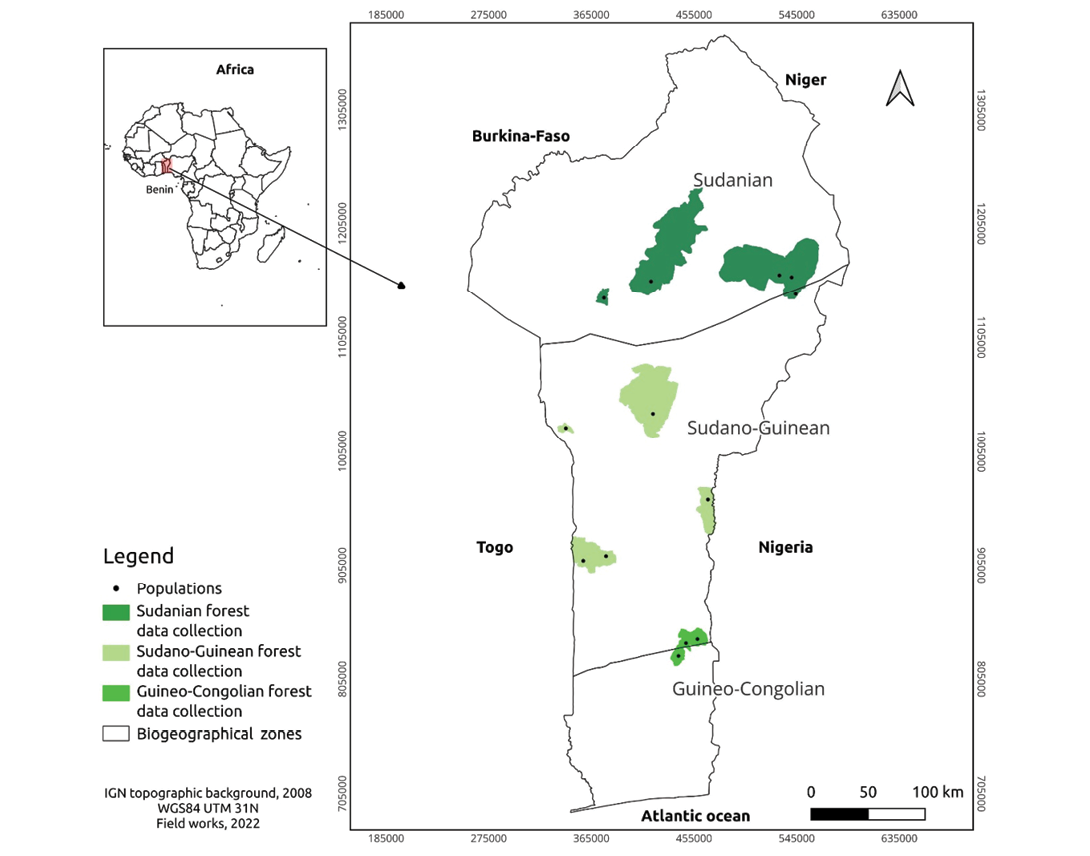
This study was conducted in Benin (6°30’ – 12°30’N, 1° – 3°40’E; ~ 112,622km²), located in West Africa, which is characterized by three distinct biogeographical zones: the Guineo-Congolian zone the Sudano-Guinean zone and the Sudanian zone (Akoègninou et al, 2006) (Figure 1). The Guineo-Congolian zone features a subequatorial climate with bimodal rainfall, experiencing a major rainy season from April to July and a high humidity range of 85% to 90% (Adomou et al, 2006). Temperatures in this zone range between 23°C and 32°C, with annual precipitation varying from 950mm to 1,400mm and are characterized by semi-deciduous forests on ferralitic soils. The Sudano-Guinean zone, located between 7° and 8°30’N, exhibits complex precipitation patterns influenced by both southern and northern climatic systems, with an average annual rainfall of 1,200mm, a temperature of 27°C, and 60% humidity. This zone is mainly characterized by wooded savannas and open forests (Adomou et al, 2006). The Sudanian zone, located between 8°30’ and 12°30’N, has a unimodal rainfall pattern, with annual precipitation ranging from 900mm to 1,100mm and an average temperature of 27.5°C (Adomou et al, 2006).
Sampling and data collection
Three forests were considered in the Sudanian zone, four in the Sudano-Guinean zone, and only one in the Guineo-Congolian zone. Across these three biogeographical zones, a total of 150 randomly selected individuals belonging to 13 populations of P. kotschyi were identified: 59 were found in the Guineo-Congolian zone, 54 in the Sudano-Guinean zone and 37 in the Sudanian zone. All samples were georeferenced using a GPS (see Table 1). Samples from Dogo-Kétou, situated within the Guineo-Congolian–Sudano-Guinean transition zone, were classified in the Guineo-Congolian zone for analytical purposes. This decision reflects the southern distribution limit of the species, which is ecologically characteristic of the Sudanian region and does not extend further into the Guineo-Congolian domain (Table 1). Measurements included diameter at breast height (DBH) and total height, assessed with appropriate instruments. Sampling involved ten leaflets and up to 30 mature fruits per tree, along with three to five seeds per fruit (Figure 2). Leaflet dimensions were measured using a graduated ruler, while fruit and seed length, width and thickness were recorded using precise electronic callipers, with weights recorded using a precision balance (Figure 2). The total number of seeds per fruit and per individual seed was documented. The measured traits are presented in Table 2.
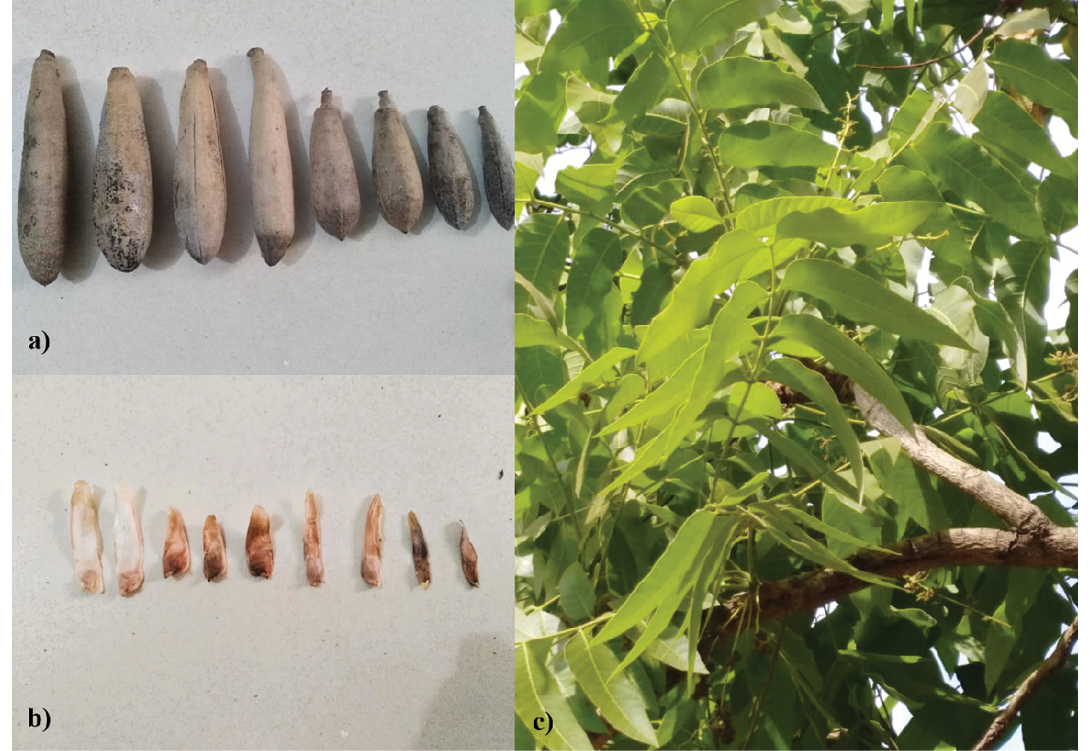
Table 1. Number of samples per biogeographical zones
|
Biogeographical zones |
No. of populations |
No. of individuals sampled |
No. of fruits |
No. of leaves |
|
Guineo-Congolian |
3 |
59 |
1,412 |
1,312 |
|
Sudano-Guinean |
5 |
54 |
1,083 |
1,193 |
|
Sudanian |
5 |
37 |
591 |
346 |
Table 2. Mean values, standard error of the mean, and coefficient of variation of the morphological characteristics of Pseudocedrela kotschyi fruits and leaves across biogeographical zones in Benin. On the same line and for each character, values with the same letters are not statistically different (Student-Newman-Keuls test). Df, degrees of freedom; F, F value; Prob, probability; N, number of samples; se, standard error; CV, coefficient of variation; GC, Guineo-Congolian; S, Sudanian; SG, Sudano-Guinean.
|
Quantitative descriptors |
GC |
S |
SG |
Df |
F |
Prob |
|
|
Fruits |
N |
1,412 |
591 |
1,083 |
2, 3083 |
||
|
mean |
1.02b |
0.96a |
1.01b |
23.03 |
< 0.001 |
||
|
se |
0 |
0.01 |
0.01 |
||||
|
CV |
0.17 |
0.25 |
0.18 |
||||
|
Seed length (cm) |
mean |
4.19c |
3.86a |
4.01b |
41.58 |
< 0.001 |
|
|
se |
0.02 |
0.03 |
0.02 |
||||
|
CV |
0.17 |
0.22 |
0.19 |
||||
|
Fruit length (cm) |
mean |
10.27b |
9.5a |
9.47a |
46.25 |
< 0.001 |
|
|
se |
0.05 |
0.08 |
0.08 |
||||
|
CV |
0.19 |
0.21 |
0.28 |
||||
|
mean |
21.00c |
18.00a |
20.00b |
64.39 |
< 0.001 |
||
|
se |
0.12 |
0.25 |
0.17 |
||||
|
CV |
0.21 |
0.33 |
0.28 |
||||
|
mean |
0.56b |
0.46a |
0.69c |
103.6 |
< 0.001 |
||
|
se |
0.01 |
0.01 |
0.01 |
||||
|
CV |
0.58 |
0.62 |
0.5 |
||||
|
Fruit weight (g) |
mean |
51.59c |
40.17a |
46.66b |
105.5 |
< 0.001 |
|
|
se |
0.39 |
0.73 |
0.53 |
||||
|
CV |
0.28 |
0.44 |
0.38 |
||||
|
Leaves |
N |
1312 |
346 |
1193 |
2, 2848 |
||
|
Leaflet width (cm) |
mean |
4.13b |
3.85a |
4.14b |
4.233 |
0.1193 |
|
|
se |
0.05 |
0.14 |
0.04 |
||||
|
CV |
0.40 |
0.66 |
0.36 |
||||
|
Leaf length (cm) |
mean |
36.24c |
27.78a |
33.57b |
163.5 |
< 0.001 |
|
|
se |
0.22 |
0.38 |
0.22 |
||||
|
CV |
0.22 |
0.26 |
0.23 |
||||
|
mean |
10.56b |
8.97a |
10.32b |
40.2 |
< 0.001 |
||
|
se |
0.08 |
0.14 |
0.09 |
||||
|
CV |
0.27 |
0.29 |
0.30 |
Data analysis
The morphological characteristics (fruit and leaf) of trees in populations from each biogeographical zone were assessed using descriptive statistics, including means, standard errors and coefficients of variation. Prior to inferential analyses, the assumptions of normality and homogeneity of variances were verified. Normality of residuals was tested using the Shapiro-Wilk test (Shapiro and Wilk, 1965), while homogeneity of variances was assessed using Levene’s test. As these assumptions were satisfied, differences in morphological traits among biogeographical zones were evaluated using a one-way analysis of variance (ANOVA). When a significant effect was detected (p < 0.05), mean comparisons were performed using the Student-Newman-Keuls (SNK) post-hoc test (Newman, 1939; Keuls, 1952). The SNK test was selected due to its suitability for detecting ordered differences among groups along ecological gradients and its effectiveness with large sample sizes, allowing a biologically meaningful interpretation of gradual morphological variation across biogeographical zones.
GPS coordinates of each sampled individual were used to extract values for 19 bioclimatic variables from the WorldClim database (http://www.worldclim.org, accessed on March 25, 2022). These bioclimatic data, representing the current climate (1970–2000), were obtained at a spatial resolution of 30 arc-seconds (Fick and Hijmans, 2017). Multicollinearity among the 19 variables (Merow et al, 2013) was tested based on a sample matrix of occurrence points and bioclimatic variables using the variance inflation factor (VIF) with the SDM package in R 3.6.3 (R Core Team, 2020) (Naimi and Araújo, 2016). A VIF threshold of < 10 was applied, following commonly used guidelines in ecological studies (Dormann et al, 2013), particularly for exploratory multivariate analyses such as principal component analysis (PCA). This threshold allowed the retention of ecologically relevant variables while limiting excessive collinearity, resulting in the selection of seven bioclimatic variables for further analysis. These are variables bio2 (mean diurnal range), bio3 (isothermality), bio5 (maximum temperature of the warmest month), bio10 (mean temperature of the warmest quarter), bio11 (mean temperature of the coldest quarter), bio12 (annual precipitation) and bio14 (precipitation of the driest month).
To identify correlations between fruit morphological traits and bioclimatic variables across biogeographical zones, PCA was conducted using the FactoMineR and factoextra packages, with prior standardization of the data. The PCA was applied to the mean values of various fruit morphological traits and corresponding bioclimatic variables by latitude to emphasize large-scale ecological gradients and reduce local-scale variability. This approach was used for exploratory purposes only and not for statistical inference. Individual-level data were retained for all hypothesis-testing analyses to avoid pseudo-replication and to preserve within-population variability. This analysis was complemented by a correlogram, which assessed pairwise relationships between morphological and bioclimatic variables using Pearson’s correlation coefficients. Statistical significance of correlations was evaluated based on associated p-values. To identify distinct fruit morphotypes, a hierarchical cluster analysis (HCA) was performed using the HCPC function of the FactoMineR package, which first applies a PCA to standardized fruit morphological traits and then conducts hierarchical clustering using Ward’s minimum variance method based on Euclidean distances calculated from the retained principal components. The resulting clusters were further analyzed through canonical discriminant analysis (CDA) to evaluate the degree of differentiation among morphotypes, using the candisc function within the same package. For each identified morphotype, the mean, standard error, and coefficient of variation were calculated for all morphological traits to describe their distinguishing characteristics. To explore the association between morphotypes and biogeographical zones, a multiple correspondence analysis (MCA) was performed using the FactoMineR package. All statistical analyses were carried out in R version 3.6.3 (R Core Team, 2020).
Results
Morphological variability of P. kotschyi according to biogeographical zones
Fruit morphological traits varied significantly across zones (p < 0.001), as did the morphological traits of the leaves (p < 0.001), except for leaflet width (p = 0.1193) (Table 2). The highest values for several traits, such as seed number (21.00 ± 0.12), seed length (4.19 ± 0.02cm), fruit weight (51.59 ± 0.39g) and leaf length (36.24 ± 0.22cm), were recorded in the Guineo-Congolian zone, followed by the Sudano-Guinean zone (Table 2). The heaviest seeds (0.69 ± 0.01g) were found in the Sudanian-Guinean zone, followed by the Guineo-Congolian zone. Seed width (1.02 ± 0cm) and leaflet length (10.56 ± 0.08cm) had the highest values in the Guineo-Congolian and Sudano-Guinean zones. The longest fruits (10.27 ± 0.05cm) were also recorded in the Guineo-Congolian zone (Table 2). The coefficient of variation (CV) indicated significant variability among the different morphological traits of fruits and leaves, ranging from 17% for maximum seed width and seed length to 58% for seed weight (Table 2).
Influence of climatic factors on the quantitative morphological characteristics of the fruits of P. kotschyi
PCA was performed on standardized morphological traits and bioclimatic variables in order to explore their joint variation and identify the main gradients structuring the data. Morphological traits were strongly associated with Axis 1, while most bioclimatic variables – except for bio2 and bio14 – align with Axis 2. Axis interpretation was based on eigenvalues > 1, variance explained, and variable loadings, with absolute loading values ≥ 0.50 considered meaningful. Axis 1 was primarily defined by high positive loadings of fruit traits, heavier and longer fruits with more seeds, mainly influenced by latitude, bio2, bio3 and bio14. Axis 2 represents climatic variation, driven by bio5, bio10, bio11 and bio12. The Sudanian zone aligns with latitude and bio2, while the Sudano-Guinean zone is influenced by bio3, bio12 and bio14. The Guineo-Congolian zone, on the other hand, exhibits the best fruit characteristics, except for seed weight, which is associated with the variables maximum temperature of the warmest month (bio5), mean temperature of the warmest quarter (bio10), and mean temperature of the coldest quarter (bio11) (Figure 3). The correlogram revealed that only a limited number of correlations between morphological traits and bioclimatic variables were statistically significant, and most exhibited moderate effect sizes (|r| < 0.5). However, the correlogram of morphological traits and climatic variables did not provide strong or unambiguous statistical evidence of robust relationships between the two groups of variables (Figure 4).
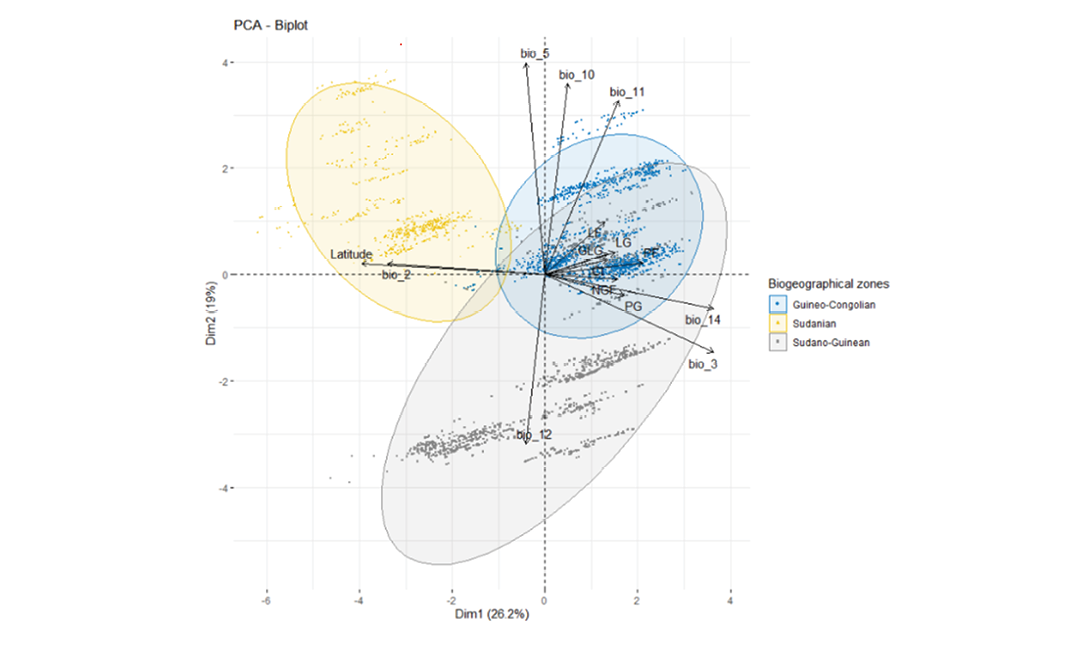
Figure 3. PCA biplot showing the distribution of Pseudocedrela kotschyi individual trait values within the axis system defined by seven bioclimatic variables and latitude. The ellipses represent 95% confidence envelopes for climatic zones. LF, fruit length (cm); PF, fruit weight (g); NGF, number of seeds per fruit; LG, seed length (cm); GLG, Seed width (cm); PG, seed weight (g); bio2, mean diurnal range; bio3, isothermality; bio5, maximum temperature of the warmest month; bio10, mean temperature of the warmest quarter; bio11, mean temperature of the coldest quarter; bio12, annual precipitation; bio14, precipitation of the driest month.
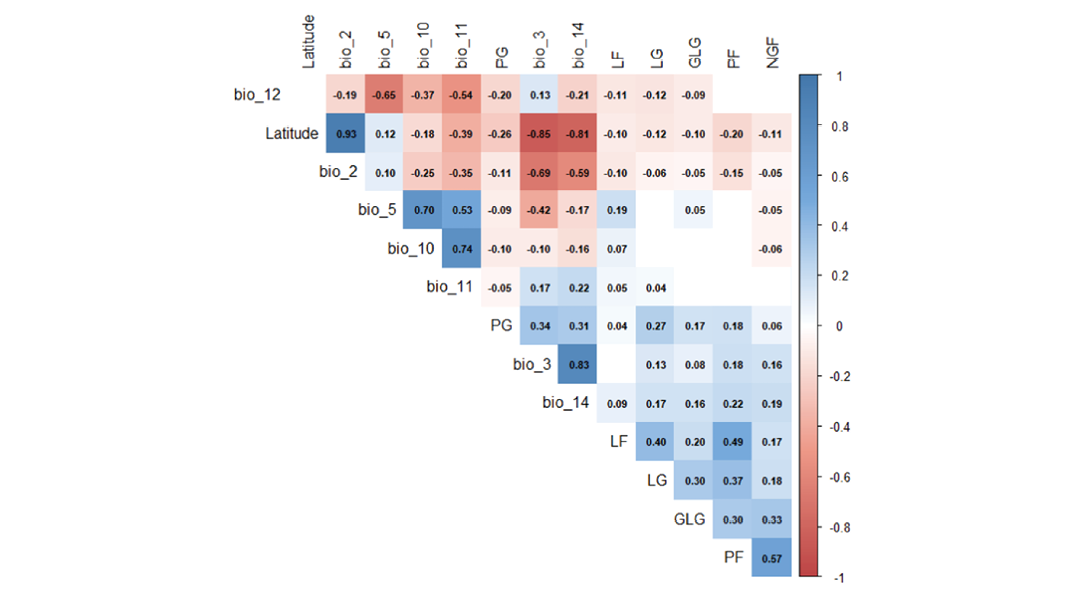
Figure 4. Correlogram of fruit morphological and climatic variables. The colour palette indicates positive (blue) and negative (red) 2 correlation coefficients. A positive coefficient indicates that the two variables move in the same direction, and a negative coefficient indicates the opposite. LF, fruit length (cm); PF, fruit weight (g); NGF, number of seeds per fruit; LG, seed length (cm); GLG, seed width (cm); PG, seed weight (g); bio2, mean diurnal range; bio3, isothermality; bio5, maximum temperature of the warmest month; bio10, mean temperature of the warmest quarter; bio11, mean temperature of the coldest quarter; bio12, annual precipitation; bio14, precipitation of the driest month.
Identification and discrimination of three distinct fruit morphotypes of P. kotschyi
Hierarchical classification identified three distinct fruit morphotypes (Figure 5). Figure 5 presents the projection of the three morphotypes in a coordinate system (first Wilks’ Lambda function = 0.101, p < 0.001; second Wilks’ Lambda function = 0.440, p < 0.001) represented by two canonical discriminant axes, which retain 100% of the initial information. Morphotypes 1 and 2 are clearly separated based on the measured morphological traits, as are morphotypes 1 and 3 (Figure 6).
Morphotype 1 is characterized by the lowest values for fruit morphological traits (Table 3). Morphotype 2 includes long fruits (10.81 ± 0.22cm) with high variability and the highest number of seeds (23 ± 0.14) with low variation. Morphotype 3 comprises heavy (0.99 ± 0.05g) and long seeds (4.46 ± 0.12cm) with little variation. Morphotypes 2 and 3 have the heaviest fruits (Table 3).
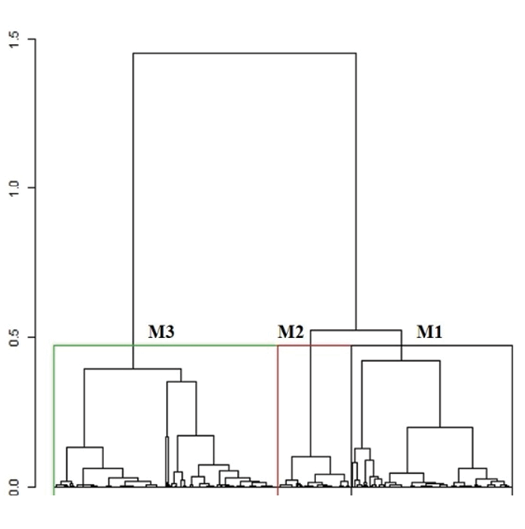
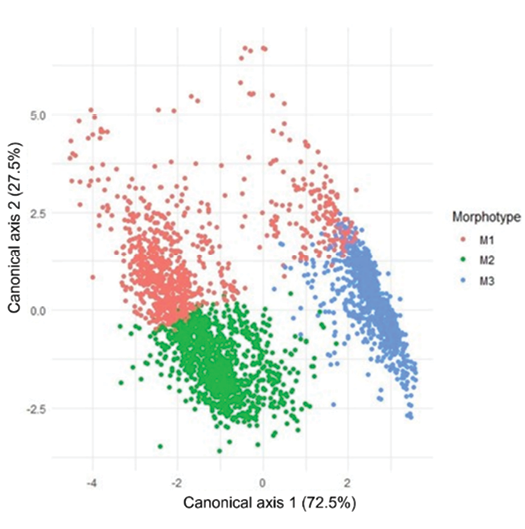
Table 3. Characteristics of three identified fruit morphotypes observed in Pseudocedrela kotschyi populations sampled in Benin. In the same row and for each trait, values sharing the same letters are not statistically different (Student-Newman-Keuls test). Prob, probability; mean, average; cv, coefficient of variation; M1, morphotype 1; M2, morphotype 2; M3, morphotype 3.
|
Quantitative descriptors |
M1 |
M2 |
M3 |
Prob |
|
|
Large seed width (cm) |
mean |
0.86a |
1.07b |
1.06b |
< 0.001 |
|
CV |
0.24 |
0.13 |
0.14 |
||
|
Seed length (cm) |
mean |
3.53a |
4.13b |
4.46c |
< 0.001 |
|
CV |
0.25 |
0.14 |
0.12 |
||
|
Fruit length (cm) |
mean |
8.28a |
10.81c |
10.18b |
< 0.001 |
|
CV |
0.21 |
0.22 |
0.18 |
||
|
Number of seeds per fruit |
mean |
15a |
23c |
21b |
< 0.001 |
|
CV |
0.38 |
0.14 |
0.16 |
||
|
Seed weight (g) |
mean |
0.43b |
0.34a |
0.99c |
< 0.001 |
|
CV |
0.66 |
0.31 |
0.05 |
||
|
Fruit weight (g) |
mean |
31.05a |
54.72b |
54.82b |
< 0.001 |
|
CV |
0.39 |
0.22 |
0.26 |
Pairwise correlation between morphological traits and biogeographical zones
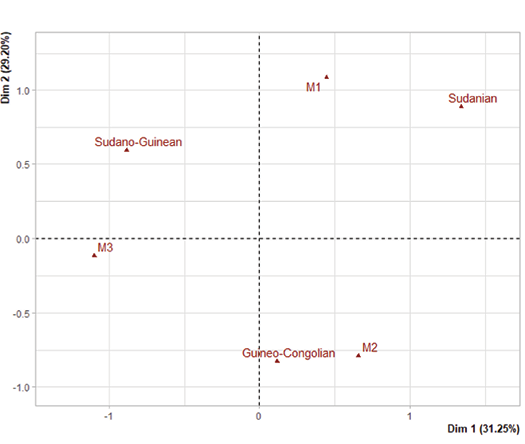
The relationships between fruit morphotypes and biogeographical zones were statistically significant (chi-square = 279.87, df = 4, p-value < 2.2e-16). The MCA captured 60.45% of the information on the first two axes (Figure 7). The Sudanian and Sudano-Guinean zones, along with morphotype 3, were the most represented variables on axis 1, while the Guineo-Congolian zone and morphotypes 1 and 2 were well represented on axis 2. Morphotype 1 was most frequent in the Sudanian zone, whereas morphotype 2 was primarily found in the Guineo-Congolian zone, and morphotype 3 is dominant in the Sudano-Guinean zone.
Discussion
Morphological variation of P. kotschyi across biogeographical zones of Benin
This study assessed the variability of leaf, fruit, and seed morphological traits of P. kotschyi and examined the role of environmental variables in the observed morphological patterns across the three biogeographical zones of Benin. The morphological characteristics of P. kotschyi fruits and leaves varied significantly between biogeographical zones. This variability reveals heterogeneity of P. kotschyi populations across distinct biogeographical regions.
The results indicated that all traits exhibited significant variation (CV > 17%). This pronounced variability of morphological traits around their mean values highlights the diversity within P. kotschyi populations. Similar patterns of intraspecific variation have been reported in other multipurpose woody species, such as Pterocarpus erinaceus (Konda et al, 2025) and Strychnos spinosa (Avakoudjo et al, 2021), which also show considerable morphological diversity across their distribution ranges. Such variation is often attributed to the heterogeneous environmental conditions under which these species grow.
The highest values for morphological traits were generally observed in the Guineo-Congolian zone. Traits such as seed number, seed length, fruit length, fruit weight and leaf length had the highest values in the Guineo-Congolian zone, followed by the Sudano-Guinean zone. Additionally, maximum seed width and leaflet length were recorded in both the Guineo-Congolian and Sudanian-Guinean zones. Other studies have also reported greater morphological trait values in the Guineo-Congolian zone, including those by Daï et al (2024) and Houehanou et al (2019). This trend may be attributed to the higher water availability in this area, where annual rainfall ranges from 950 to 1,400mm (Adomou et al, 2006).
The high seed weight observed in the Sudano-Guinean zone could be explained by the presence of an ecological optimum. This zone likely offers a favourable combination of factors, such as temperature, seasonal humidity and soil structure; this promotes the development of heavier seeds, which are advantageous for seedling survival. For example, a study on Prosopis africana in Benin demonstrated that fruit traits (including seed weight) were significantly adapted to climatic zones, with the highest values recorded in areas with the most favourable ecological conditions (coefficient of variation up to 58%) (Towanou et al, 2015). Similarly, the Sudano-Guinean zone may represent an ecological optimum for P. kotschyi, where environmental conditions maximize seed weight, even though this trait does not follow the same pattern as other morphological traits.
Furthermore, this observation may be attributed to the presence of the species in agroecosystems of the Guineo-Congolian zone, where it is relatively more protected due to its utility compared to the other two zones (Deguenonvo et al, 2024). Based on these findings, we conclude that the Guineo-Congolian zone would be the most suitable for a conservation and domestication programme of P. kotschyi in Benin.
Influence of climatic and environmental factors on morphological traits of P. kotschyi
The study found no strong correlation between morphological traits and bioclimatic variables. This may be partly explained by the species’ distribution range, which does not fully extend across all latitudes of the Guineo-Congolian zone. Indeed, P. kotschyi is ecologically classified as a Sudanian species, and individuals sampled in the so-called Guineo-Congolian zone were located near the transitional boundary with the Sudano-Guinean zone. Therefore, the limited latitudinal range of occurrence in the southern zone may restrict the expression of morphological responses to broader climatic gradients. Similar observations have been made in other studies, where the ecological amplitude of species influences their trait-environment relationships (Assogbadjo et al, 2011). Moreover, integrating additional variables – such as genetic diversity and soil properties - could provide a more comprehensive understanding of the factors driving morphological variability (Freschet et al, 2017).
The low values observed for morphological traits, such as small seeds and small fruits in Sudanian zone, could be attributed to hot climates, which may affect their overall quality and viability. At higher latitudes, fruit and seed characteristics tend to exhibit lower values. High latitudes often result in reduced fruit and seed sizes, as observed in various species, including Cynodon dactylon, where latitude significantly influences morphological traits (Zhang et al, 2018). Moreover, in the Guineo-Congolian zone, where temperature conditions are optimal, P. kotschyi tends to produce larger and heavier fruits. This finding aligns with the results of Hounkpèvi et al (2016) on Vitex doniana Sweet.
Relationship between fruit morphotypes and biogeographical zones
The identification and classification of fruit morphotypes are essential steps in understanding plant diversity and adaptation across different biogeographical zones. The analysis of P. kotschyi fruit morphological traits allowed the distinction of three morphotypes, each associated with specific climatic conditions. Hierarchical classification revealed three distinct types based on morphological traits. These morphotypes differed in characteristics such as fruit length, seed number and seed weight, which are essential for plant reproduction and survival. Discriminate analysis confirmed the distinctive nature of these morphotypes, highlighting the role of morphological traits in ecological and evolutionary processes. This classification aligned with findings from other studies on fruit and seed morphometry, which highlighted the importance of these traits in plant adaptation and evolutionary processes (Adjacou et al, 2024; Houndonougbo et al, 2020).
Morphotype 1 was characterized by the lowest values of fruit morphological traits, indicating potential adaptation to more arid conditions with a high diurnal temperature range (bio2) and the influence of latitude. This aligns with the observed trend where higher latitudes lead to reduced fruit and seed sizes (Zhang et al, 2018). Morphotype 2 consisted of longer fruits with significant variation in length, possibly reflecting a strategy that enhances seed dispersal and optimal germination (Avakoudjo et al, 2021; Lawin et al, 2021; Daï et al, 2024). Morphotype 3 included heavy and long seeds, and high biomass production (Houndonougbo et al, 2020), which benefit seedling establishment and are likely to promote good germination and growth of P. kotschyi seedlings, as reported for Uvaria chamae by Daï et al (2024) and for Cola millenii by Lawin et al (2021). Heavier seeds may improve seedling survival by enhancing resilience to rainfall variability and specific edaphic conditions (Freschet et al, 2017).
Perspectives for the domestication and sustainable management of P. kotschyi in Benin
The results indicate that the Guineo-Congolian zone presents favourable conditions for the conservation and potential domestication of P. kotschyi, particularly for objectives related to vegetative growth and potential timber production. This zone provides higher water availability, moderate temperatures and enhanced protection of individuals within agroecosystems, which may support better vegetative growth and timber yield (Deguenonvo et al, 2024). However, when considering domestication for fruit or seed production, the Sudano-Guinean zone may offer more optimal conditions. This is supported by the observation that seed weight - an important trait for reproductive success and seedling establishment – was significantly higher in this zone, possibly reflecting an ecological optimum for reproductive performance.
Although P. kotschyi seeds are not currently utilized in human food systems, their potential for future industrial applications, such as medicinal use or oil extraction, may increase interest in their production. Consequently, both biogeographical zones offer strategic value depending on domestication objectives: the Guineo-Congolian zone is better suited for timber production and conservation, while the Sudano-Guinean zone presents greater potential for enhancing fruit traits and seed valorization. To support in situ and ex situ conservation strategies, we recommend the following actions: (1) preserve natural populations in the Guineo-Congolian zone, (2) investigate genetic diversity to better understand adaptation mechanisms and domestication potential, and (3) engage local communities actively in conservation efforts by integrating them into management programmes to enhance sustainability.
Conclusion
This study reveals notable morphological variation in P. kotschyi across Benin’s biogeographical zones, influenced by environmental factors such as rainfall, temperature and latitude. Three distinct fruit morphotypes were identified, illustrating the species’ adaptability to diverse climates. The Guineo-Congolian zone proved most favourable, producing larger and heavier fruits and seeds that enhance dispersal and seedling survival. However, the weak correlation between morphological traits and climatic variables suggests that other factors, particularly soil conditions and genetic diversity, may also shape this variability. These insights underscore the importance of adopting an integrated approach to conservation and domestication. Combining morphological, ecological and genetic data is essential to understanding the species’ adaptive potential. Sustainable strategies, including protecting natural populations, selecting productive morphotypes and involving local communities, are crucial for ensuring the long-term survival of P. kotschyi. Such approaches will contribute to biodiversity conservation and the development of climate-resilient agroforestry systems in Benin.
Acknowledgements
The authors would like to thank the Alexander von Humboldt Foundation for its support for this study through equipment grant 3.4-8151/Houehanou (GA-Nr.).
TAGD and TDH Houehanou conceived the research. TAGD, DMA and TDH developed the methodology. TAGD, TDH, RS and FEDS conducted formal analysis and investigation. TAGD, DMA, RI and TDH wrote the original draft. TDH acquired the funding, provided the resources, and supervised the research. All authors participated in the review and editing of the manuscript.
Data availability statement
Accession-level data are available from the corresponding author upon reasonable request.
Conflict of interest statement
The authors have no relevant financial or non-financial interests to disclose.
References
Adjacou, D.M., Houehanou, D.T., Gouwakinnou, N.G., Prinz, K., Moussa, T., Mama, A.-R., Hellwig, F., Natta, K.A., 2024. Local knowledge and morphological variations in local landraces Mangifera indica L. in Northern Benin (West Africa). Afr. J. Agric. Res. 20, 650–666. https://doi.org/10.5897/AJAR2024.16678
Adjacou, D.M., Houehanou, T.D., Gouwakinnou, G.N., Natta, A.K., 2022. Connaissances ethnoécologiques des variétés locales de Mangifera indica L. dans l’Atacora au Bénin : usages, diversité et perceptions du changement climatique. Ann. UP, Série Sci. Nat. Agron. 12, 15–28. https://doi.org/10.56109/aup-sna.v12i1.107
Adomou, A.C., Sinsin, B., van der Maesen, L.J.G., 2006. Notulae florae beninensis 12: phytosociological and chorological approaches to phytogeography: a meso-scale study in Benin. Systematics and geography of plants 155–178.
Akoègninou, A., Van der Burg, W.J., Van der Maesen, L.J.G., 2006. Flore analytique du Bénin. Backhuys Publishers.
Alhassan, A.M., Ahmed, Q.U., Malami, I., Zakaria, Z.A., 2021. Pseudocedrela kotschyi: a review of ethnomedicinal uses, pharmacology and phytochemistry. Pharmaceutical Biology 59, 953–961. https://doi.org/10.1080/13880209.2021.1950776
Arbonnier, M., 2019. Arbres, arbustes et lianes d’Afrique de l’Ouest: Nouvelle édition 2019. Quae.
Assédé, E.P., Adomou, A.C., Sinsin, B., 2012. Relationship between stand regime and population structure of Pseudocedrela kotschyi (Meliaceae) and Terminalia macroptera (Combretaceae) in the Biosphere Reserve of Pendjari (Benin, West Africa). International Journal of Biodiversity and Conservation 4, 427–438. doi: https://doi.org/10.5897/IJBC12.028
Assogbadjo, A.E., Glegrave, R., Azihou, A.F., Kyndt, T., Codjia, J.T.C., 2011. Ethnic differences in use value and use patterns of the threatened multipurpose scrambling shrub (Caesalpinia bonduc L.) in Benin. Journal of Medicinal Plants Research 5, 1549–1557. http://hdl.handle.net/1854/LU-1256575
Avakoudjo, H.G.G., Idohou, R., Salako, K.V., Hounkpèvi, A., Koné, M.W., Assogbadjo, A.E., 2021. Diversity in tree and fruit traits of Strychnos spinosa Lam. along a climatic gradient in Benin: a step towards domestication. Genet Resour Crop Evol 68, 2423–2440. https://doi.org/10.1007/s10722-021-01140-5
Daï, E.H., Salako, K.V., Hotes, S., Assogbadjo, A.E., 2024. Morphological variability of ‘bush banana’ (Uvaria chamae) and its environmental determinants in Benin, West Africa. Genet Resour Crop Evol 71, 4049–4065. https://doi.org/10.1007/s10722-024-01926-3
Deguenonvo, A.G., Dossou, J., Idohou, R., 2020. Aptitude à la multiplication de Pseudocedrela kotschyi (Schweinf.) Harms par graines et par boutures de tige et de racine au Bénin. International Journal of Biological and Chemical Sciences 14, 2506–2516. https://doi.org/10.4314/ijbcs.v14i7.11
Deguenonvo, T.A.G., Adjacou, D.M., Idohou, R., Sodedja, R., Sobakin, F.E.D., Houehanou, T.D., Gouwakinnou, G.N., Natta, A.K., 2024. Synergizing climate dynamics, species distribution, and structural parameters for sustainable management of Pseudrocedrela kotschyi in Benin (West Africa). Global Ecology and Conservation 56, e03322. https://doi.org/10.1016/j.gecco.2024.e03322
Deguenonvo, T.A.G., Houehanou, T.D., Adjacou, D.M., Sobakin, F.E.D., Sodedja, R., Gouwakinnou, G.N., Natta, A.K., 2023a. Effet de la zone climatique et de la perturbation humaine sur la composition floristique et la diversité des habitats de Pseudocedrela kotschyi au Benin : Effect of climatic zone and human disturbance on floristic composition and diversity of Pseudocedrela kotschyi habitats in Benin. International Journal of Biological and Chemical Sciences 17, 2299–2311. https://dx.doi.org/10.4314/ijbcs.v17i6.13
Deguenonvo, T.A.G., Houehanou, T.D., Idohou, R., Yehouenou, N., Gouwakinnou, G.N., Natta, A.K., 2023b. Uses, Cultural Importance, and Fire Threat to Pseudocedrela kotschyi (Meliaceae): Evidence for the Availability Hypothesis in Benin (West Africa). Economic Botany 1–19. doi: https://doi.org/10.1007/s12231-023-09581-y
Diarra, M.L., Mariko, M., Mbaye, M.S., Noba, K., 2016. Plantes médicinales utilisées dans le traitement traditionnel du paludisme à Bamako (Mali). International Journal of Biological and Chemical Sciences 10, 1534–1541. doi: http://dx.doi.org/10.4314/ijbcs.v10i4.7
Dormann, C.F., Elith, J., Bacher, S., Buchmann, C., Carl, G., Carré, G., Marquéz, J.R.G., Gruber, B., Lafourcade, B., Leitão, P.J., Münkemüller, T., McClean, C., Osborne, P.E., Reineking, B., Schröder, B., Skidmore, A.K., Zurell, D., Lautenbach, S., 2013. Collinearity: a review of methods to deal with it and a simulation study evaluating their performance. Ecography 36, 27–46. https://doi.org/10.1111/j.1600-0587.2012.07348.x
Dossa, L.O.S.N., Dassou, G.H., Adomou, A.C., Ahononga, F.C., Biaou, S., 2021. Dynamique spatio-temporelle et vulnérabilité des unités d’occupation du sol de la Forêt Classée de Pénéssoulou de 1995 à 2015 (Bénin, Afrique de l’Ouest). Sciences de la vie, de la terre et agronomie 9.
Fick, S.E., Hijmans, R.J., 2017. WorldClim 2: new 1-km spatial resolution climate surfaces for global land areas. International journal of climatology 37, 4302–4315. doi: https://doi.org/10.1002/joc.5086
Freschet, G.T., Valverde-Barrantes, O.J., Tucker, C.M., Craine, J.M., McCormack, M.L., Violle, C., Fort, F., Blackwood, C.B., Urban-Mead, K.R., Iversen, C.M., Bonis, A., Comas, L.H., Cornelissen, J.H.C., Dong, M., Guo, D., Hobbie, S.E., Holdaway, R.J., Kembel, S.W., Makita, N., Onipchenko, V.G., Picon-Cochard, C., Reich, P.B., de la Riva, E.G., Smith, S.W., Soudzilovskaia, N.A., Tjoelker, M.G., Wardle, D.A., Roumet, C., 2017. Climate, soil and plant functional types as drivers of global fine-root trait variation. Journal of Ecology 105, 1182–1196. https://doi.org/10.1111/1365-2745.12769
Grubben, G.J.H., 2008. Plant resources of tropical Africa (PROTA). Prota.
Houehanou, T.D., Prinz, K., Hellwig, F., Assogbadjo, A.E., Gebauer, J., Kakaï, R.L.G., Sinsin, B., 2019. Morphological trait variation and relationships of Afzelia africana Sm. caused by climatic conditions and anthropogenic disturbance in Benin (West Africa). Genetic Resources and Crop Evolution 66, 1091–1105. https://doi.org/10.1007/s10722-019-00773-x
Houehanou, T.D., Prinz, K., Koua, D., Hellwig, F., Ebou, A., Gouwakinnou, G., Assogbadjo, A.E., Glele Kakaï, R.L., Zézé, A., 2023. Genetic diversity and population structure of a threatened tree species Afzelia africana Sm. ex Pers. among climatic zones for conservation challenges in Benin (West Africa). Genetic Resources and Crop Evolution 1–16. doi: https://doi.org/10.1007/s10722-022-01523-2
Houndonougbo, J.S.H., Kassa, B., Salako, V.K., Idohou, R., Assogbadjo, A.E., Glèlè Kakaï, R., 2020. Perceived variation of fruit traits, and preferences in African locust bean [Parkia biglobosa (Jacq.) Benth.] in Benin: implications for domestication. Genet Resour Crop Evol 67, 1315–1329. https://doi.org/10.1007/s10722-020-00915-6
Hounkpèvi, A., Azihou, A.F., Kouassi, É.K., Porembski, S., Glèlè Kakaï, R., 2016. Climate-induced morphological variation of black plum (Vitex doniana Sw.) in Benin, West Africa. Genet Resour Crop Evol 63, 1073–1084. https://doi.org/10.1007/s10722-016-0409-9
Hounkpèvi, A., Salako, V.K., Donhouédé, J.C.F., Daï, E.H., Tovissodé, F., Glèlè Kakaï, R., Assogbadjo, A.E., 2020. Natural intraspecific trait variation patterns of the wild soursop Annona senegalensis (Annonaceae) along a climatic gradient in Benin, West Africa. Plant Ecology and Evolution 153, 455–465. doi: https://doi.org/10.5091/plecevo.2020.1576
Ikabanga, D.U., Stévart, T., Koffi, K.G., Monthé, F.K., Doubindou, E.C.N., Dauby, G., Souza, A., M’batchi, B., Hardy, O.J., 2017. Combining morphology and population genetic analysis uncover species delimitation in the widespread African tree genus Santiria (Burseraceae). Phytotaxa 321, 166–180. https://doi.org/10.11646/phytotaxa.321.2.2
Keuls, M., 1952. The use of the „studentized range” in connection with an analysis of variance. Euphytica 1, 112–122.
Konda, B., Dimobe, K., Salako, K.V., Dembélé, J.B., Boussim, I.J., 2025. Morphological variability of Pterocarpus erinaceus Poir. along a climate gradient in Burkina Faso, West Africa: implications for conservation and domestication. Genet Resour Crop Evol. https://doi.org/10.1007/s10722-024-02310-x
Lawin, I.F., Fandohan, A.B., Salako, K.V., Assogbadjo, A.E., Ouinsavi, C.A.I.N., 2021. Morphological variability of fruits of Cola millenii K. Schum. from seven phytogeographical districts in Benin: opportunity for domestication. Genetic Resources and Crop Evolution 68, 1225–1242. doi: https://doi.org/10.1007/s10722-020-01086-0
Mars, M., Marrakchi, M., 2000. Étude de la variabilité intra-arbre chez le grenadier (Punica granatum L.): application à l’échantillonnage des fruits. Fruits 55, 347–355.
Merow, C., Smith, M.J., Silander Jr, J.A., 2013. A practical guide to MaxEnt for modeling species’ distributions: what it does, and why inputs and settings matter. Ecography 36, 1058–1069. doi: https://doi.org/10.1111/j.1600-0587.2013.07872.x
Moussilimi, I.T., Koura, K., Aoudji, A.K.N., Gbetoho, J.A., Akouehou, G.S., Ganglo, J.C., 2022. Caractéristiques structurales et écologiques des populations de Pseudocedrela kotschyi de la forêt de Pénéssoulou (Bénin). Annales de l’Université de Parakou - Série Sciences Naturelles et Agronomie 12, 13–26. https://doi.org/10.56109/aup-sna.v12i2.122
Naimi, B., Araújo, M.B., 2016. sdm: a reproducible and extensible R platform for species distribution modelling. Ecography 39, 368–375. https://doi.org/10.1111/ecog.01881
Newman, D., 1939. The distribution of range in samples from a normal population, expressed in terms of an independent estimate of standard deviation. Biometrika 31, 20–30.
Ouattara, B., Sanou, L., Koala, J., Hien, M., 2022. Perceptions locales de la dégradation des ressources naturelles du corridor forestier de la Boucle du Mouhoun au Burkina Faso. Bois & Forets des Tropiques 352, 43–60. doi: https://doi.org/10.19182/bft2022.352.a36935
R. Core Team, 2020. R: A language and environment for statistical computing. R Foundation for Statistical Computing, Vienna, Austria. url: https://www.R-project.org/.
Shapiro, S.S., Wilk, M.B., 1965. An analysis of variance test for normality (complete samples). Biometrika 52, 591–611.
Stévart, T., Dauby, G., Lowry, P.P., Blach-Overgaard, A., Droissart, V., Harris, D.J., Mackinder, B.A., Schatz, G.E., Sonké, B., Sosef, M.S.M., Svenning, J.-C., Wieringa, J.J., Couvreur, T.L.P., 2019. A third of the tropical African flora is potentially threatened with extinction. Sci. Adv. 5, eaax9444. https://doi.org/10.1126/sciadv.aax9444
Towanou, H., Charlemagne, G.D.S.J., Christine, O., Nestor, S., 2015. Morphological Variability of Prosopis africana (Guill., Perrott. Et Rich.) Taub in Benin, West Africa. American Journal of Plant Sciences 6, 1069–1079. https://doi.org/10.4236/ajps.2015.67111
White, F., 1983. The vegetation of Africa.
Yaoitcha, A.S., Aboh, A.B., Zoffoun, A.G., Houinato, M., Mensah, G.A., Sinsin, B., Akpo, E.L., 2016. Potentiel de régénération des chantiers de production du charbon de bois au Centre-Bénin. International Journal of Biological and Chemical Sciences 10, 1702–1716. https://doi.org/10.4314/ijbcs.v10i4.21
Yusuf, S.N.A., Rahman, A.M.A., Zakaria, Z., Subbiah, V.K., Masnan, M.J., Wahab, Z., 2020. Morphological Variability Identification of Harumanis Mango (Mangifera indica L.) Harvested from Different Location and Tree Age. Trop Life Sci Res 31, 107–143. https://doi.org/10.21315/tlsr2020.31.2.6
Zhang, J., Wang, M., Guo, Z., Guan, Y., Guo, Y., Yan, X., 2018. Variations in morphological traits of bermudagrass and relationship with soil and climate along latitudinal gradients. Hereditas 155, 31. https://doi.org/10.1186/s41065-018-0068-2
Zida, D., Sanou, L., Diawara, S., Savadogo, P., Thiombiano, A., 2020. Herbaceous seeds dominates the soil seed bank after long-term prescribed fire, grazing and selective tree cutting in savanna-woodlands of West Africa. Acta Oecologica 108, 103607. https://doi.org/10.1016/j.actao.2020.103607