
Characterizing genetic diversity within and between native Nordic horse breeds utilizing and comparing the EquCab3.0 and EquCab_Finn reference genomes
Article Sidebar
Main Article Content
Abstract
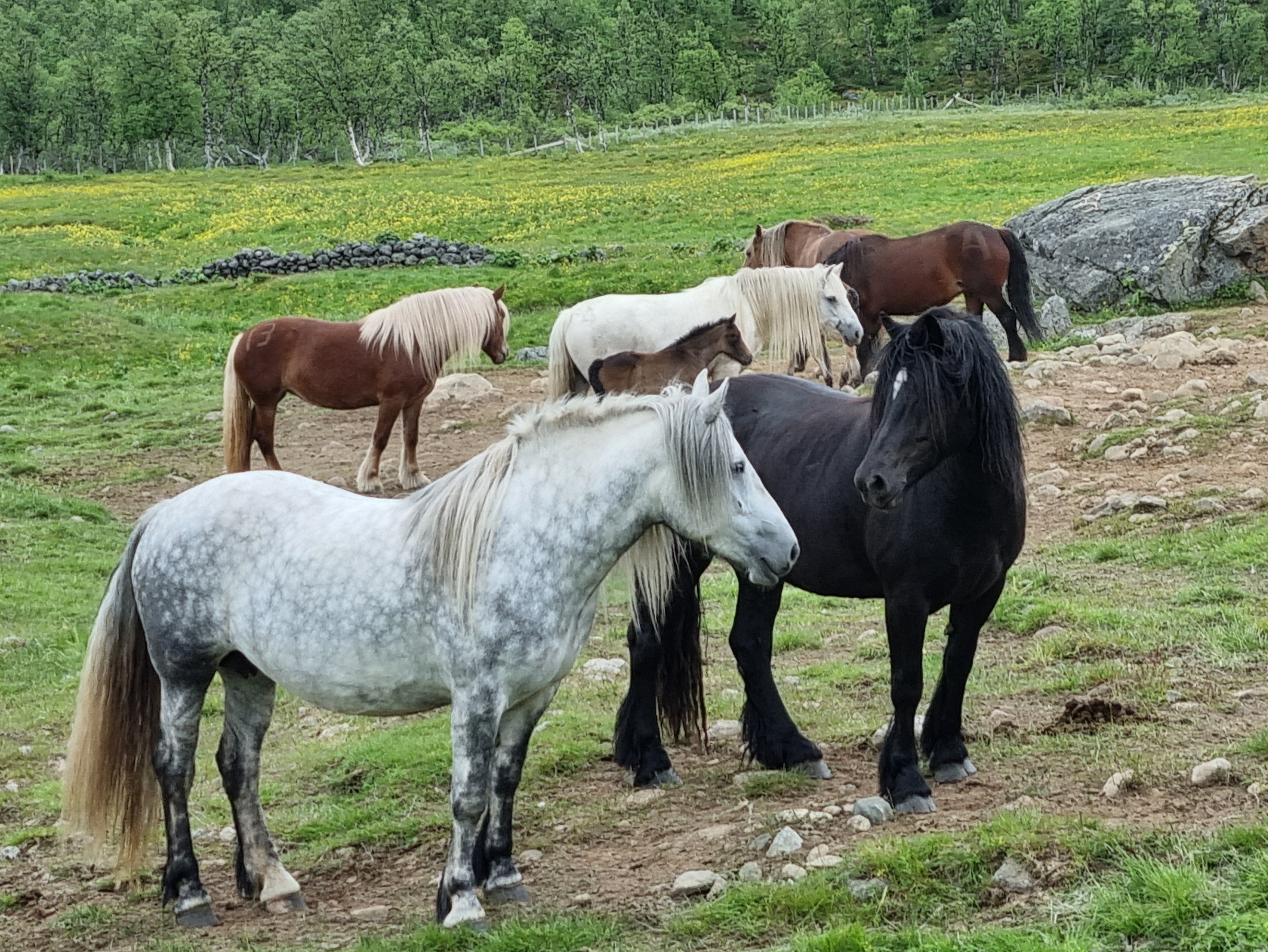
Sustainable breeding of native breeds is essential to preserve genetic diversity and cultural heritage. Several native Nordic horse breeds are at risk of extinction and lack genetic characterization. This study aimed to analyze genetic variation and kinship within and among native Nordic horse breeds using whole genome sequence data, and to compare results from using a Finnhorse genome assembly to that of the EquCab3.0 (Thoroughbred) reference genome. The breeds Dola horse, North Swedish horse and Coldblooded Trotter showed close genetic relationship for fixation index (0.04-0.10), and in principal component analysis. The other breeds showed stronger genetic differentiation, especially the Faroese horse with fixation index above 0.21 to all other breeds. This breed had the highest genomic inbreeding of 33% and a heterozygosity of 12%. The Swedish Ardennes showed the lowest inbreeding at 14% and a heterozygosity of 16%. The North Swedish horses had the highest historical Ne of 96, estimated 13 generations back in time, and the Faroese horse the lowest (23). The mean identity by descent varied from 17% for Swedish Ardennes to 40% for Faroese horses. The choice of reference genomes gave minor to moderate differences, suggesting that a closer related reference improves precision for fine mapping and understanding of genetic landscapes of Nordic breeds. Together, the different analyses showed low genetic diversity in all breeds, and the general pattern of relatedness largely agreed with the known breed history. The results underline the importance of maintaining genetic diversity for the survival of the breeds.
Article Details

This work is licensed under a Creative Commons Attribution 4.0 International License.
Authors retain copyright of the articles published in Genetic Resources and grant the journal right of first publication with open access. All articles published in Genetic Resource are licensed under Creative Commons Attribution 4.0 International License (CC BY 4.0) that allows others to download, share and adapt the work for commercial and non-commercial purposes as long as proper attribution to the original article is given. Genetic Resources permits and encourages authors to post items submitted to the journal (including the publisher's final layout) on personal websites or institutional repositories after acceptance and/or publication, while providing bibliographic details that credit their publication in Genetic Resources.




Adepoju, D., Ohlsson, J. I., Klingström, T., Rius-Vilarrasa, E., Johansson, A. M., and Johnsson, M. (2024). Population history of Swedish cattle breeds: estimates and model checking. bioRxiv, 1-28. doi: https://doi.org/10.1101/2024.10.03.616479
Andersson, L. (2016). Analysis of inbreeding in the Swedish Gotland pony using pedigree information and microsatellite markers. M.Sc. Thesis. Swedish University of Agricultural Sciences, Uppsala.
Andrews, S. (2010). FastQC: a quality control tool for high throughput sequence data. url: http://www.bioinformatics.babraham.ac.uk/projects/fastqc
Barbato, M., Orozco-terWengel, P., Tapio, M., and Bruford, M. W. (2015a). SNeP: A tool to estimate trends in recent effective population size trajectories using genome-wide SNP data. Frontiers in Genetics, 6, 109. doi: https://doi.org/10.3389/fgene.2015.00109
Barbato, M., Orozco-terWengel, P., Tapio, M., and M.W., B. (2015b). SNeP. url: https://sourceforge.net/projects/snepnetrends/
Berglund, P., Andonov, S., Strandberg, E., and Eriksson, S. (2024). Should performance at different race lengths be treated as genetically distinct traits in Coldblooded trotters? J. Anim. Breed. Genet., 141(2), 220–234 doi: https://doi.org/10.1111/jbg.12837
Bhatia, G., Patterson, N., Sankararaman, S., and Price, A. L. (2013). Estimating and interpreting FST: The impact of rare variants. GenomeResearch, 23, 1514–1521. doi: https://doi.org/10.1101/gr.154831.113
Bjørnstad, G., Gunby, E., and Røed, K. H. (2000). Genetic structure of Norwegian horse breeds. J. Anim. Breed. Genet., 117, 307-317. doi: https://doi.org/10.1046/j.1439-0388.2000.00264.x
Bjørnstad, G., Nilsen, N., and Røed, K. H. (2003). Genetic relationship between Mongolian and Norwegian horses? Animal Genetics, 34, 55-58. doi: https://doi.org/10.1046/j.1365-2052.2003.00922.x
Bjørnstad, G., and Røed, K. H. (2001). Breed demarcation and potential for breed allocation of horses assessed by microsatellite markers. Animal Genetics, 32, 59-65. doi: https://doi.org/10.1046/j.1365-2052.2001.00705.x
Bjørnstad, G., and Røed , K. H. (2002). Evaluation of factors affecting individual assignment precision using microsatellite data from horse breeds and simulated breed crosses. Animal Genetics, 33, 264–270. doi: https://doi.org/10.1046/j.1365-2052.2002.00868.x
Broad Institute. (2020). Picard Toolkit. url: https://broadinstitute.github.io/picard/
Broad Institute. (2025). Genome Analysis Toolkit (GATK). url: https://gatk.broadinstitute.org
Carlström, O., Aaby-Ericsson, A., and Wilhelmsson, F. (1946). Betänkande med förslag till åtgärder för främjande av ridhästaveln m.m. (Vol. 1946:45).(Stockholm: Kungliga boktryckeriet P.A. Nordstedt & Söner).
Chang, C. C., Chow, C. C., Tellier, L. C. A. M., Vattikuti, S., Purcell, S. M., and Lee, J. J. (2015). Second-generation PLINK: rising to the challenge of larger and richer datasets. GigaScience, 4(1), 7. doi: https://doi.org/10.1186/s13742-015-0047-8
Chen, C., Zhu, B., Tang, X., Chen, B., Liu, M., Gao, N., et al. (2023). Genome-Wide Assessment of Runs of Homozygosity by Whole-Genome Sequencing in Diverse Horse Breeds Worldwide. Genes, 14(6), 1211. doi: https://doi.org/10.3390/genes14061211
Corbin, L. J., Blott, S. C., Swinburne, J. E., Vaudin, M., Bishop, S. C., and Woolliams, J. A. (2010). Linkage disequilibrium and historical effective population size in the Thoroughbred horse. Animal Genetics, 41(s2), 8-15. doi: https://doi.org/10.1111/j.1365-2052.2010.02092.x
Corbin, L. J., Liu, A. Y. H., Bishop, S. C., and Woolliams, J. A. (2012). Estimation of historical effective population size using linkage disequilibria with marker data. J. Anim. Breed. Genet., 129, 257-270. doi: https://doi.org/10.1111/j.1439-0388.2012.01003.x
Danecek, P., Bonfield, J. K., Liddle, J., Marshall, J., Ohan, V., Pollard, M. O., et al. (2021). Twelve years of SAMtools and BCFtools. GigaScience, 10(2), 1-4. doi: https://doi.org/10.1093/gigascience/giab008
De Meeûs, T. (2018). Revisiting FIS, FST, Wahlund Effects, and Null Alleles. Journal of Heredity, 109(4), 446–456. doi: https://doi.org/10.1093/jhered/esx106
Det Norske Travselskap, and Svensk Travsport. (2019). Avelsplan för kallblods travare. url: Https://www.kallblodstravaren.se/contentassets/07906d194ac2452dad9504e90db9adfd/beslutad-svensk-norsk-avelsplan-2019-06-13.pdf
Domínguez-Viveros, J., Molina-Villalobos, J. R., Camacho-Sandoval, J., Cruz-Méndez, A., Martínez-Rocha, R., and Jahuey-Martínez, F. (2024). Structure and genetic variability of the Costa Rican Paso horse. Journal of Equine Veterinary Science, 132, 104985. doi: https://doi.org/10.1016/j.jevs.2023.104985
European Variation Archive (EVA). (n.d.). EMBL-EBI Catalog of equine genetic variation. url: https://www.ebi.ac.uk/eva/?eva-study=PRJEB47918
FAO. (2022). Status and Trends of Animal Genetic Resources - 2022. In 12th Session of the Intergovernmental Technical Working Group on Animal Genetic Resources for Food and Agriculture, Rome. https://www.fao.org/3/cc3705en/cc3705en.pdf
FAO. (2024). Domestic Animal Diversity Information System (DAD-IS). url: https://www.fao.org/dad-is/browse-by-country-and-species/en/
Fegraeus, K. J., Velie, B. D., Axelsson, J., Ang, R., Hamilton, N. A., Andersson, L., et al. (2018). A potential regulatory region near the EDN3 gene may control both harness racing performance and coat color variation in horses. Physiological Reports, 6(10), e13700. doi: https://doi.org/10.14814/phy2.13700
Föreningen Nordsvenska Hästen. (2019). Avelsprogram och reglementen för nordsvensk brukshäst. url: https://nordsvensken.org/wp-content/uploads/2019/12/AVELSPROGRAM-2019.pdf?utm_source=chatgpt.com
Frichot, E., and François, O. (2015). LEA: an R package for Landscape and Ecological Association studies. Methods in Ecology and Evolution, 6(8), 925-929. doi: https://doi.org/10.1111/2041-210X.12382
Gain, C., and François, O. (2021). LEA 3: Factor models in population genetics and ecological genomics with R. Molecular Ecology Resources, 21(8), 2738-2748. doi: https://doi.org/10.1111/1755-0998.13366
Gmel, A. I., Mikko, S., Ricard, A., Velie, B., Gerber, V., Hamilton, N. A., et al. (2024). Using high-density SNP data to unravel the origin of the Franches-Montagnes horse breed. Genetics Selection Evolution, 56(53). doi: https://doi.org/10.1186/s12711-024-00922-6
Gopalakrishnan, S., Samaniego Castruita, J. A., Sinding, M. H. S., Kuderna, L. F. K., Räikkönen, J., Petersen, B., et al. (2017). The wolf reference genome sequence (Canis lupus lupus) and its implications for Canis spp. population genomics. BMC Genomics, 18, 495. doi: https://doi.org/10.1186/s12864-017-3883-3
Greenacre, M., Groenen, P. J. F., Hastie, T., D’Enza, A. I., Markos, A., and Tuzhilina, E. (2022). Principal Component Analysis. Nature Reviews Methods Primers, 2, 100. doi: https://doi.org/10.1038/s43586-022-00184-w
Hästnäringens Nationella Stiftelse. (2021). Hästar och Uppfödare i Sverige. Nyckeltal för svensk hästuppfödning under åren 2016 - 2020 url: https://hastnaringen.se/app/uploads/2021/12/avelsrapport-2021-hastar-och-uppfodare-i-sverige.pdf
Hudson, R. R., Slatkint, M., and Maddison, W. P. (1992). Estimation of Levels of Gene Flow From DNA Sequence Data. Genetics, 132(2), 583–589. doi: https://doi.org/10.1093/genetics/132.2.583
Joensen, S. K. (2024). The Genomic Diversity and Population Structure of the Faroese Horse; The first ever whole-genome study. M.Sc. Thesis. University of Copenhagen, Copenhagen.
Kettunen, A., Joensen, S. K., and Berg, P. (2022). Optimum contribution selection (OCS) analyses prompted successful conservation actions for Faroese horse population. Genetic Resources, 3, 59-67. doi: https://doi.org/10.46265/genresj.KKXV5870
Kierkegaard, L. S., Groeneveld, L. F., Kettunen, A., and Berg, P. (2020). The status and need for characterization of Nordic animal genetic resources. Acta Agric. Scand. A Anim. Sci., 69(1-2), 2-24. doi: https://doi.org/10.1080/09064702.2020.1722216
Kjetså, M., Gerðinum, J. I., Ólavsdóttir, J., M., J., Kallsoy Joensen, S., Honkatukia, M., et al. (2024). Action Plan for the Conservation of the Faroese Horse. url: https://www.nordgen.org/media/w4sbtasg/action-plan-for-the-conservation-of-the-faroese-horse.pdf
Landslaget for Dølahest. (2024). Avlsplan dølahest. url: https://www.dolehesten.no/avlsplan/
Leroy, G., Gicquel, E., Boettcher, P., Besbes, B., Furre, S., Fernandez, J., et al. (2020). Coancestry rate’s estimate of effective population size for genetic variability monitoring. Conserv Genet Resour(12), 275-283. doi: https://doi.org/10.1007/s12686-019-01092-0
Li, H., and Durbin, R. (2009). Fast and accurate short read alignment with Burrows–Wheeler transform. Bioinformatics, 25(14), 1754-1760. doi: https://doi.org/10.1093/bioinformatics/btp324
Li, Y., Liu, Y., Wang, M., Lin, X., Li, Y., Yang, T., et al. (2022). Whole-Genome Sequence Analysis Reveals the Origin of the Chakouyi Horse. Genes, 13(12), 2411. doi: https://doi.org/10.3390/genes13122411
Lloret-Villas, A., Bhati, M., Kadri, N. K., Fries, R., and Pausch, H. (2021). Investigating the impact of reference assembly choice on genomic analyses in a cattle breed. BMC Genomics, 22, 363. doi: https://doi.org/10.1186/s12864-021-07554-w
Manunza, A., Cozzi, P., Boettcher, P., Curik, I., Looft, C., Colli, L., et al. (2025). Estimating the optimal number of samples to determine the effective population size in livestock. Frontiers in Genetics, 16, 1588986. doi: https://doi.org/10.3389/fgene.2025.1588986
McGivney, B. A., Han, H., Corduff, L. R., Katz, L. M., Tozaki, T., MacHugh, D. E., et al. (2020). Genomic inbreeding trends, influential sire lines and selection in the global Thoroughbred horse population. Scientific Reports, 10, 466. doi: https://doi.org/10.1038/s41598-019-57389-5
Melheim, M. (2017). Genetisk Variasjon og Clusteranalyse på Bakgrunn av Slektskapsdata hjå Dølahest. M.Sc. thesis. Norwegian University of Life Sciences, Aas.
Meyermans, R., Gorssen, W., Buys, N., and Janssens, S. (2020). How to study runs of homozygosity using PLINK? A guide for analyzing medium density SNP data in livestock and pet species. BMC Genomics, 21, 94. doi: https://doi.org/10.1186/s12864-020-6463-x
Nazareno, A. G., Bemmels, J. B., Dick, C. W., and Lohmann, L. G. (2017). Minimum sample sizes for population genomics: an empirical study from an Amazonian plant species. Molecular Ecology Resources, 17, 1136-1147. doi: https://doi.org/10.1111/1755-0998.12654
NCBI. (2018). Genome Assembly EquCab3.0; The Equine Reference Genome. url: https://www.ncbi.nlm.nih.gov/datasets/genome/GCF_002863925.1/
Norsk Hestesenter. (2023). Nøkkeltal om dei nasjonale hesterasane. url: https://img2.custompublish.com/getfile.php/5302809.2562.zsmbl7szjszw77/N%C3%B8kkeltallsrapport%2B2023_web.pdf?return=www.nhest.no
Olsen, H. F., Klemetsdal, G., Ruane, J., and Helfjord, T. (2010). Pedigree structure and genetic variation in the two endangered Norwegian horse breeds: Døle and Nordland/Lyngen. Acta Agric. Scand. A Anim. Sci., 60(1), 13-22. doi: https://doi.org/10.1080/09064701003639884
Olsen, H. F., Tenhunen, S., Dolvik, N. I., Våge, D. I., and Klemetsdal, G. (2020). Segment-based coancestry, additive relationship and genetic variance within and between the Norwegian and the Swedish Fjord horse populations. Acta Agric. Scand. A Anim. Sci., 69(1-2), 118-126. doi: https://doi.org/10.1080/09064702.2019.1711155
Petersen, J. L., Mickelson, J. R., Cleary, K. D., and McCue, M. E. (2014). The American Quarter Horse: Population Structure and Relationship to the Thoroughbred. Journal of Heredity, 105(2), 148–162. doi: https://doi.org/10.1093/jhered/est079
Petersen, J. L., Mickelson, J. R., Cothran, E. G., Andersson, L. S., Axelsson, J., Bailey, E., et al. (2013). Genetic Diversity in the Modern Horse Illustrated from Genome-Wide SNP Data. PLoS One, 8(1), e54997. doi: https://doi.org/10.1371/journal.pone.0054997
Pokharel, K., Weldenegodguad, M., Reilas, T., and Kantanen, J. (2024). EquCab_Finn: A new reference genome assembly for the domestic horse, Finnhorse. Animal Genetics, 33(5), 766-771. doi: https://doi.org/10.1111/age.13463
Poplin, R., Ruano-Rubio, V., DePristo, M. A., Fennell, T. J., Carneiro, M. O., Van der Auwera, G. A., et al. (2018). Scaling accurate genetic variant discovery to tens of thousands of samples. bioRxiv, 1-22. doi: https://doi.org/10.1101/201178
Purcell, S., and Chang, C. (2005). PLINK 1.9. url: www.cog-genomics.org/plink/1.9/
Purcell, S., and Chang, C. (2017). PLINK 2.0. url: www.cog-genomics.org/plink/2.0/
Purcell, S., Neale, B., Todd-Brown, K., Thomas, L., Ferreira, M. A. R., Bender, D., et al. (2007). PLINK: A tool set for whole-genome association and population-based linkage analyses. The American Journal of Human Genetics, 81(3), 559-575. doi: https://doi.org/10.1086/519795
Ryman, N., Laikre, L., and Hössjer, O. (2019). Do estimates of contemporary effective population size tell us what we want to know? Molecular Ecology, 28(8), 1904-1918. doi: https://doi.org/10.1111/mec.15027
Schurink, A., Shrestha, M., Eriksson, S., M., B., Bovenhuis, H., Back, W., et al. (2019). The Genomic Makeup of Nine Horse Populations Sampled in the Netherlands. Genes, 10(6), 480. doi: https://doi.org/10.3390/genes10060480
Siekas, A.-C. (2006). Populationsstruktur och genetisk analys av exteriöra egenskaper hos svensk ardenner. M.Sc. thesis. Swedish University of Agricultural Sciences, Uppsala.
Sigurðardóttir, H., Ablondi, M., Kristjansson, T., Lindgren, G., and Eriksson, S. (2024). Genetic diversity and signatures of selection in Icelandic horses and Exmoor ponies. BMC Genomics, 25, 772. doi: https://doi.org/10.1186/s12864-024-10682-8
Sild, E., Rooni, K., Värv, S., Røed, K., Popov, R., Kantanen, J., et al. (2019). Genetic diversity of Estonian horse breeds and their genetic affinity to northern European and some Asian breeds. Livestock Science, 220, 57-66. doi: https://doi.org/10.1016/j.livsci.2018.12.006
Smogeli, N. A. (2023). Unraveling the Genetic Mysteries of the Norwegian Fjord-horse: Identifying Harmful Haplotypes for Improved Breeding Strategies. M.Sc. Thesis. Norwegian University of Life Sciences, Aas.
Stroupe, S., Millar, T., Raudsepp, T., Andersson, L., Petersen, J., Kalbfleish, T., et al. (2024). Equine pangenome graph identifies novel structural and single nucleotide variants. In 14th International Havemeyer Foundation Horse Genome Workshop, Caen. https://www.pure.ed.ac.uk/ws/portalfiles/portal/443373075/Abstracts-book-040524.pdf
Svensk Travsport. (2024). Kallblodstravarnas betäckningssiffror för 2024. url: https://www.travsport.se/arkiv/nyheter/2024/oktober/kallblodstravarnas-betackningssiffror-for-2024/
Svenska Hästavelsförbundet. (2024). Betäckningssiffor 2024. url: https://svehast.se/wp-content/uploads/2024/11/Betackningssiffror_2024.pdf.
Svenska Russavelsföreningen. (2019). Svenska Russavelsföreningens avelsprogram samt avelsplan för avel med gotlandsruss 2020. url: https://usercontent.one/wp/www.gotlandsruss.se/wp-content/uploads/2020/02/2020-Svenska-Russavelsf%C3%B6reningens-avelsprogram-samt-avelsplan-f%C3%B6r-avel-med-gotlandsruss.pdf
Thorburn, D.-M., Sagonas, K., Binzer-Panchal, M., Chain, F. J. J., Feulner, P. G. D., Bornberg-Bauer, E., et al. (2023). Origin matters: Using a local reference genome improves measures in population genomics. Molecular Ecology Resources, 23(7), 1706–1723. doi: https://doi.org/10.1111/1755-0998.13838
Van der Auwera, G. A., and O'Connor, B. D. (2020). Genomics in the Cloud: Using Docker, GATK, and WDL in Terra (1st Edition).(Sebastopol, California: O'Reilly Media).
Velie, B. D., Lillie, M., Fegraeus, K. J., Rosengren, M. K., Solé, M., Wiklund, M., et al. (2019a). Exploring the genetics of trotting racing ability in horses using a unique Nordic horse model. BMC Genomics, 20, 104 (2019). doi: https://doi.org/10.1186/s12864-019-5484-9
Velie, B. D., Solé, M., Fegraeus, K. J., Rosengren, M. K., Røed, K. H., Ihler, C.-F., et al. (2019b). Genomic measures of inbreeding in the Norwegian-Swedish Coldblooded Trotter and their associations with known QTL for reproduction and health traits. Genetics Selection Evolution, 51, 22. doi: https://doi.org/10.1186/s12711-019-0465-7
Viklund, Å., Näsholm, A., Strandberg, E., and Philipsson, J. (2011). Genetic trends for performance of Swedish Warmblood horses. Livestock Science, 141(2-3), 113-122. doi: https://doi.org/10.1016/j.livsci.2011.05.006
Weldenegodguad, M., Popov, R., Pokharel, K., Ammosov, I., Ming, Y., Ivanova, Z., et al. (2019). Whole-Genome Sequencing of Three Native Cattle Breeds Originating From the Northernmost Cattle Farming Regions. Frontiers in Genetics, 9, 728. doi: https://doi.org/10.3389/fgene.2018.00728
White, E.-L. F., Honkatukia, M., Peippo, J., and Kjetså, M. (2024). Equines in the Nordics: History, Status and Genetics. url: https://www.norden.org/en/publication/equines-nordics-history-status-and-genetics
Wright, S. (1922). Coefficients of inbreeding and relationship. American Naturalist, 56(645), 330–338. url: http://www.jstor.org/stable/2456273
Zhdanova, O. L., and Pudovkin, A. I. (2008). Nb_HetEx: A Program to Estimate the Effective Number of Breeders. Journal of Heredity, 99(6), 694–695. doi: https://doi.org/10.1093/jhered/esn061
 This journal has been conceived as part of the