
Phenomic characterization of Crotalaria germplasm in Embrapa’s genebank, Brazil
Article Sidebar
Main Article Content
Abstract
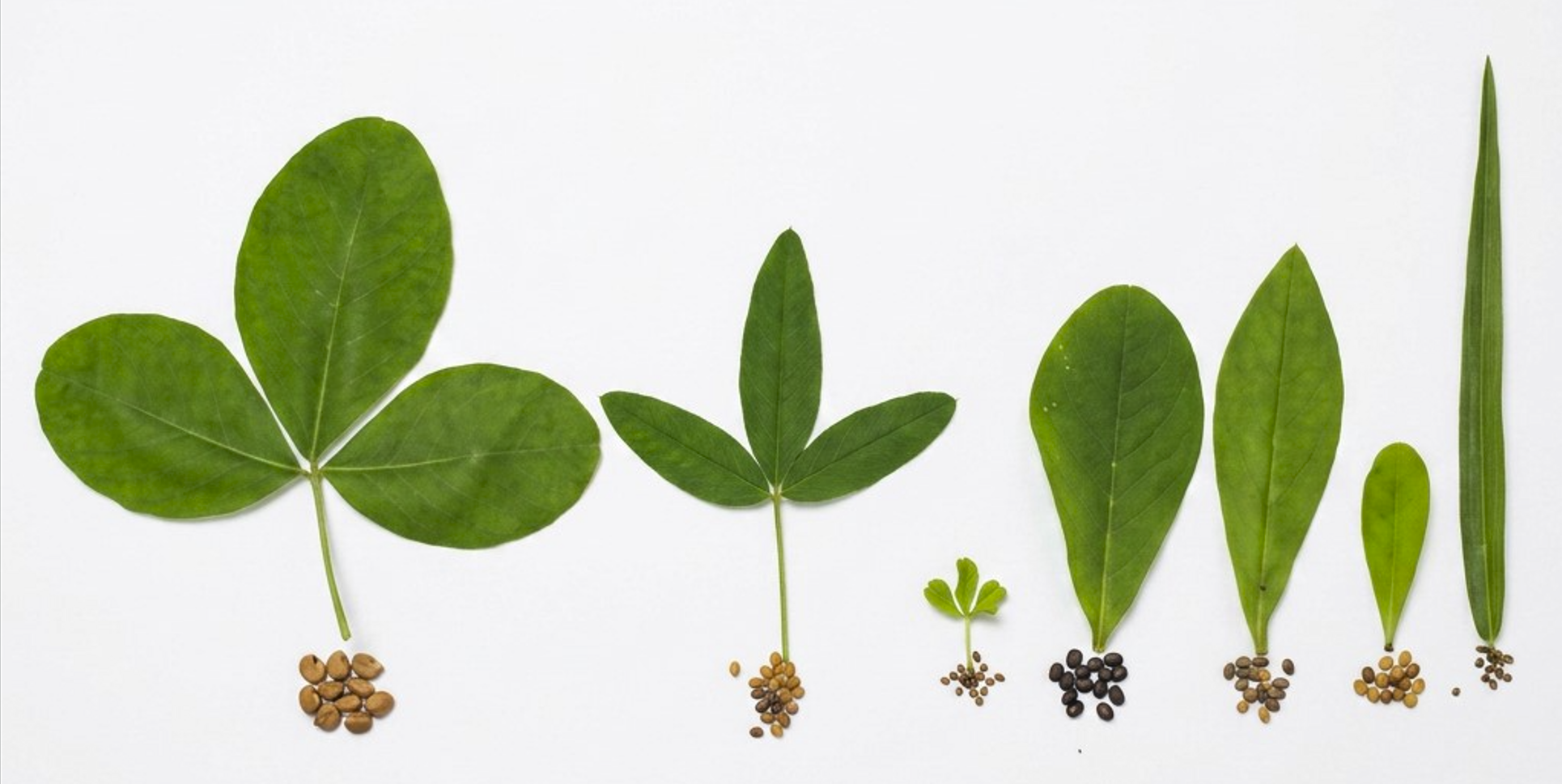
This study aimed to evaluate the morphological diversity of 22 Crotalaria accessions conserved in the Embrapa Cerrados germplasm bank, Brazil, with emphasis on their potential use in breeding and genetic resource management. Sixteen morphological descriptors were analyzed, revealing substantial phenotypic variation among accessions. Plant height ranged from 45 to 146cm, and leaflet and seed traits also showed broad variation, reflecting a wide adaptive spectrum. The Shannon–Weaver (H) and Simpson (D) diversity indices indicated consistently high diversity across traits (mean H = 0.964; mean D = 0.940), confirming the existence of a rich genetic base within the collection. Principal component analysis showed that the first two components explained 63.72% of total variance, with reproductive traits such as seed length, seed width, and 100-seed weight contributing most to variation among accessions. Cluster analysis grouped the accessions into five distinct morphological clusters, identifying genotypes with superior plant vigour, leaf area, or seed characteristics as potential parents for future breeding programmes. The observed morphological variability highlights the significant genetic diversity within Crotalaria germplasm, supporting its value for selection, hybridization and conservation. The combination of diversity indices and multivariate analyses provides a robust framework for identifying promising accessions for breeding programmes targeting biomass production, seed yield and environmental adaptation. These findings reinforce the importance of maintaining and characterizing germplasm collections as strategic reservoirs for sustainable crop improvement and the long-term conservation of genetic resources.
Article Details

This work is licensed under a Creative Commons Attribution 4.0 International License.
Authors retain copyright of the articles published in Genetic Resources and grant the journal right of first publication with open access. All articles published in Genetic Resource are licensed under Creative Commons Attribution 4.0 International License (CC BY 4.0) that allows others to download, share and adapt the work for commercial and non-commercial purposes as long as proper attribution to the original article is given. Genetic Resources permits and encourages authors to post items submitted to the journal (including the publisher's final layout) on personal websites or institutional repositories after acceptance and/or publication, while providing bibliographic details that credit their publication in Genetic Resources.




Abranches, M. de O., da Silva, G. A. M., dos Santos, L. C., Pereira, L. F., de Freitas, G. B. (2021). Contribution of green fertilization to the chemical, physical and biological characteristics of the soil and its influence on the nutrition of vegetables. Research, Society and Development 10, e3210716351. doi: https://doi.org/10.33448/rsd-v10i7.16351
Arone, G. J., Ocaña, R., Sánchez, A., Villadas, P. J., Fernández-López, M. (2024). Benefits of Crotalaria juncea L. as green manure in fertility and soil microorganisms on the Peruvian coast. Microorganisms 12, 2241. doi: https://doi.org/10.3390/microorganisms12112241
Bolleddu, R., Debajyoti, D., Das, M., Sahu, D., Mangal, A., Babu, G., Venkata, P., Prasad, P. (2023). Pharmacognostical and phytochemical studies of Crotalaria retusa L. (Shanapuspi) dried roots. Journal of Drug Research in Ayurvedic Sciences 8, 370–376. doi: https://doi.org/10.4103/jdras.jdras_31_23
Carvalho, M. A., Quesenberry, K. H. (2009). Morphological characterization of the USA Arachis pintoi Krap. and Greg. collection. Plant Systematics and Evolution 277, 1–11. doi: https://doi.org/10.1007/s00606-008-0089-9
da Silva, B. N. P., Masetto, T. E., Garcia, R. A., Toledo, M. Z. (2022). Row spacing and seed physiological quality of Crotalaria species. Pesq. Agropec. Trop. 52, e72674. doi: https://doi.org/10.1590/1983-40632022v5272674
Daimon, H. (2006). Traits of the Genus Crotalaria Used as a Green Manure Legume on Sustainable Cropping Systems. JARQ 40, 299–305. doi: https://doi.org/10.6090/jarq.40.299
Devecchi, M. F., Pirani, J. R., Melo-de-Pinna, G. F. d. A. (2014). Comparative leaf anatomy and morphology of some Brazilian species of Crotalaria L. (Leguminosae: Papilionoideae: Crotalarieae). Acta Botanica Brasilica 28, 583–593. doi: https://doi.org/10.1590/0102-33062014abb3517
Ferreira, E. A., et al (2021). Fixação biológica de nitrogênio em leguminosas de cobertura. Cadernos de Agroecologia 16, 2. doi: https://doi.org/10.22308/cadernosdeagroecologia.v16i2.17256
Fu, Y. B., et al (2015). Understanding crop genetic diversity under modern plant breeding. Theor Appl Genet 128, 2131–2142. https://doi.org/10.1007/s00122-015-2585-y
Gnan, S., Priest, A. and Kover, P.X., 2014. The genetic basis of natural variation in seed size and seed number and their trade-off using Arabidopsis thaliana MAGIC lines. Genetics, 198(4), pp.1751-1758. doi: https://doi.org/10.1534/genetics.114.170746
Guerra, J. G. M., Espíndola, J. A. A., Perin, A., Teixeira, M. G., Almeida, D. L. de, Assis, R. L. de (2007). Desempenho de leguminosas tropicais perenes como plantas de cobertura do solo. Embrapa Agrobiologia, Boletim de Pesquisa e Desenvolvimento 20. url: https://www.infoteca.cnptia.embrapa.br/infoteca/handle/doc/622591
Koudahe, K., Allen, S. C., Djaman, K. (2022). Critical review of the impact of cover crops on soil properties. International Soil and Water Conservation Research 10, 343–354. doi: https://doi.org/10.1016/j.iswcr.2022.03.003
Lanna, A. C., Silva, M. A., Moreira, A. S., Nascente, A. S., Filippi, M. C. C. de (2021). Improved nutrient uptake in three Crotalaria species inoculated with multifunctional microorganisms. Rev. Bras. Eng. Agríc. Ambient. 25, 460–465. doi: https://doi.org/10.1590/1807-1929/agriambi.v25n7p460-465
Lima Filho, O. F., et al, eds. (2023). Adubação verde e plantas de cobertura no Brasil: fundamentos e prática (Brasília, DF: Embrapa), 586 p.
Muli, J. K., Neondo, J.O., Kamau, P.K. et al. Phenomic characterization of Crotalaria germplasm for crop improvement. CABI Agric Biosci 2, 10 (2021). https://doi.org/10.1186/s43170-021-00031-0
Muli, J. K., Neondo, J. O., Kamau, P. K., Michuki, G. N., Odari, E., Budambula, N. L. M. (2022). Genetic diversity and population structure of wild and cultivated Crotalaria species based on genotyping-by-sequencing. PLOS ONE 17, e0272955. doi: https://doi.org/10.1371/journal.pone.0272955
Muli, J. K., Neondo, J. O., Budambula, N. L. M. (2025). Agro-morphological diversity of edible Kenyan Crotalaria accessions. Scientific African 27, e02620. doi: https://doi.org/10.1016/j.sciaf.2025.e02620
Müller-Samann, K. M., Kotschi, J. (1994). Sustaining growth: soil fertility management in tropical small holdings (United Kingdom: Technical Centre for Agricultural and Rural Cooperation), 486 p.
National Research Council. (1979). Tropical legumes: resources for the future (Washington, D.C.: National Academy of Science), 331 p.
Nelson, C. J., Moser, L. E. (1994). Plant factors affecting forage quality. In Forage Quality, Evaluation, and Utilization, ed. G. C. Fahey Jr., M. Collins, D. R. Mertens, L. E. Moser (Madison, WI: ASA, CSSA, SSSA), 115–154.
Odhoch, P. S., Budambula, N. L. M., Kiprotich, F., Muli, J. K. (2025). Exploring genetic diversity: Optimizing simple sequence repeat (SSR) markers in Crotalaria for enhanced precision in biodiversity research. Scientifica (Cairo) 2025, 2409286. doi: https://doi.org/10.1155/sci5/2409286
Oka, Y. (2010). Mechanisms of nematode suppression by organic soil amendments—A review. Appl. Soil Ecol. 44, 101–115. doi: https://doi.org/10.1016/j.apsoil.2009.11.003
Polhill, R. M. (1968). Miscellaneous notes on African species of Crotalaria L. II. Kew Bulletin 22, 169–337. doi: https://doi.org/10.2307/4107762
R Core Team. (2024) R: A Language and Environment for Statistical Computing. R Foundation for Statistical Computing. https://www.R-project.org/
Royal Horticultural Society (2015). RHS Colour Chart (6th ed.). London: Royal Horticultural Society. [Plate 155D]
Sayed, M. R. I., et al (2022). Genetic diversity, analysis of some agro-morphological and quality traits and utilization of plant resources of alfalfa. Genes 13, 1521. doi: https://doi.org/10.3390/genes13091521
Silva, J. L., Almeida, J., Sousa, M., Silva, E. (2018). Crotalária: usos e potencialidades no Cerrado. In Anais do III Congresso Internacional das Ciências Agrárias (COINTER PDVAgro), João Pessoa. doi: https://doi.org/10.31692/2526-7701.XCOINTERPDVAgro.2018.00033
Shannon, C.E., Weaver, W., 1949. The Mathematical Theory Communication. University of Illinois Press, Urbana.
Simpson, E. H. (1949). Measurement of diversity. Nature 163, 688. doi: https://doi.org/10.1038/163688a0
Solbrig, O. T. (1994). Plant traits and adaptive strategies: their role in ecosystem function. In Biodiversity and Ecosystem Function, ed. E.-D. Schulze, H. A. Mooney (Berlin: Springer), 97–116.
Sokal, R. R., & Michener, C. D. (1958). A statistical method for evaluating systematic relationships. University of Kansas Science Bulletin, 38, 1409-1438. [1, 2, 3]
Upadhyaya, H. D., Bramel, P.J., Ortiz, R. et al. (2002) Geographical patterns of diversity for morphological and agronomic traits in the groundnut germplasm collection. Euphytica 128, 191–204. https://doi.org/10.1023/A:1020835419262
Wang, K.-H., Sipes, B. S., Schmitt, D. P. (2002). Crotalaria as a cover crop for nematode management: a review. Nematropica 32, 35–58. url: https://journals.flvc.org/nematropica/article/view/69643
Ward, J. H., Jr. (1963). "Hierarchical grouping to optimize an objective function." Journal of the American Statistical Association, 58(301), 236-244.
Weraduwage, S. M., Chen, J., Anozie, F. C., Morales, A., Weise, S. E., Sharkey, T. D. (2015). The relationship between leaf area growth and biomass accumulation in Arabidopsis thaliana. Frontiers in Plant Science 6, 167. doi: https://doi.org/10.3389/fpls.2015.00167
Yaradua, S. S., et al (2018). Numerical taxonomic study of the genus Crotalaria L. (Crotalarieae, Fabaceae) in Nigeria. Biodiversity Research and Conservation, vol. 50, no. 1, Adam Mickiewicz University, pp. 25-32. https://doi.org/10.2478/biorc-2018-0005
 This journal has been conceived as part of the